Review
All-Inclusive vs. Self-Catering: Which Booking Model Fits?
Which accommodation type makes financial sense for a beach holiday depends on travel style and duration. A comparison without hype.
TravelFeelings Editorial Team7 min.
Germany · Coastal Mecklenburg-Vorpommern
The Baltic Sea offers fine sandy beaches, charming seaside resorts, and family-friendly amenities—a budget-conscious alternative to Mediterranean destinations for families.
The Baltic Sea coast is not an exotic long-haul destination but a proven family travel region with over a century of tourism infrastructure. The islands of Rügen, Usedom, and Fehmarn—along with the coastal regions of Mecklenburg-Vorpommern—offer practical amenities with both advantages and the inevitable quirks of an established destination.
Sellin Pier on Rügen is the region’s most iconic landmark. Built in 1913, this 394-meter wooden structure is Instagram gold for millions. The classic route descends via a 78-step staircase, but a free lift serves families with prams and wheelchair users. At the pier’s end sits a restaurant with views across open water.
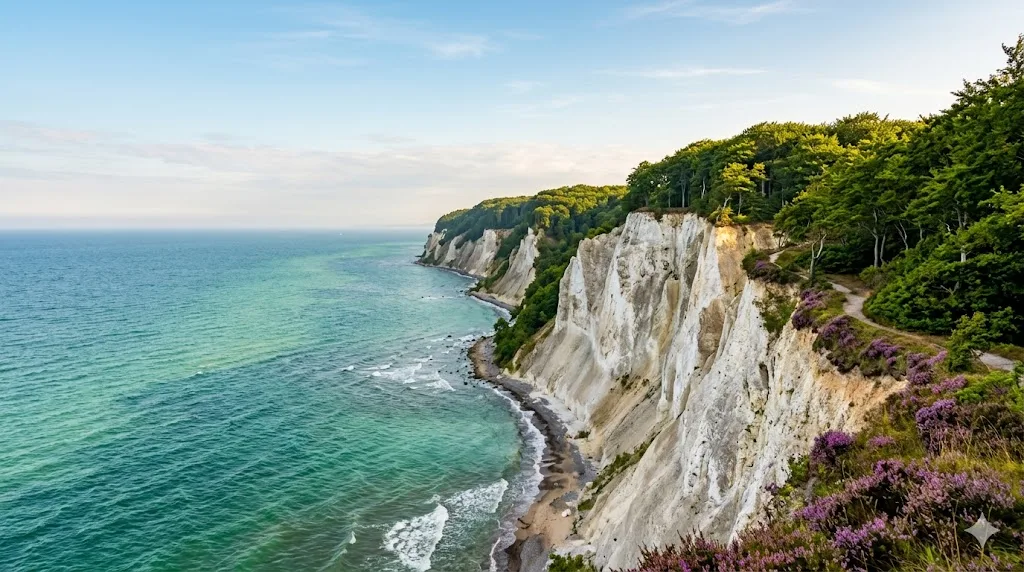
Rügen’s chalk cliffs form less a single attraction than a geological landscape. What geologists call “Kreidetafeln”—chalk plateaus—the Baltic has carved here: 70-meter-high white cliff walls, topped with heather moorland and forest, below a rocky shoreline. The Hochufer hiking trail connects several viewpoints. Not pushchair-friendly, but manageable for primary school-aged children.
Peenemünde Phenomenon on Usedom is a hands-on science exhibition with over 300 interactive experiments across 2,500 square meters. Focus: natural sciences for self-directed learning, not a museum for very young children, but highly engaging for ages 6–14. Entry is around 10 euros; one hour is insufficient, three hours realistic.
The Historical-Technical Museum Peenemünde complements Phenomenon: a former rocket factory turned exhibition space covering local history and space technology. Adults find more here than children, but it is not presented as dark military history but rather as technical heritage.
Dinosaur Park Mölschow on Usedom displays 90 life-sized dinosaur models outdoors. Entry around 12 euros. Best as a half-day activity. Target audience: children aged 4–10.
The Usedom Butterfly Farm is Europe’s largest butterfly farm with over 1,000 living specimens. Entry around 9 euros, visit roughly one hour. Ideal for younger children and worthwhile May–September when butterfly activity peaks.
Passenger ferries depart from several harbors: Binz, Sellin, and Göhren on Rügen, plus Usedom. Standard routes visit chalk cliffs, bird sanctuaries, or Cape Arkona (Rügen’s northernmost point). Duration 2–4 hours, adult fares from 15 euros. Suitable for those prone to seasickness—routes are brief and the Baltic less turbulent than the North Sea. The Baltic ranks among Europe’s top family destinations for summer travel for good reason.
Rasender Roland is a heritage railway connecting Binz and Göhren over 24 kilometers via steam locomotive. Journey time about 80 minutes one way. Opened in 1895, original cars still operate. Multi-journey packages cheaper than single fares.
Stralsund, just 30 kilometers from Rügen, is a UNESCO World Heritage site (Old Town) featuring red-brick Gothic and harbor charm. One day trip suffices. The Maritime Museum here merits half a museum day.
A Stralsund excursion works from any point on Rügen. The Old Town is walkable; Greifswald Castle lies en route (60 kilometers from Sellin). Driving time roughly 45 minutes each way.
Greifswald is a university town with a restored Old Town, similar to Stralsund but less touristy. Worth visiting for culture enthusiasts, less essential for pure beach-holiday families.
Hiddensee island is tiny (19 square kilometers), car-free, reachable only by ferry (from Rügen’s Schaprode or Vierow). Full-day excursion: ferry (90 minutes), explore island on foot, return. Ideal for families seeking tranquility and authentic Baltic seaside atmosphere.
Karls Adventure Farm on Usedom is a working-farm theme park with tractor rides, ponies, and strawberry-picking activities. Entry around 10–15 euros. Half a day suffices. Target age: 4–10 years.
Nature reserves around Greifswald (Peenetal, Pomeranian Lagoon Landscape) offer hiking and bird-watching. No tourist attractions per se, but naturalist exploration. Best for families prioritizing nature over infrastructure.
Ahrenshoop seaside resort, west of Rügen, has been an artist colony since 1890 and sees far fewer crowds than Sellin or Binz. Restaurants and galleries maintain a bohemian character. A night or two here breaks the standard Rügen itinerary.
Cape Arkona in Rügen’s north is reachable not just by ship but by bicycle (40 kilometers from Sellin). The lighthouse and chalk cliffs are spectacular. The route is flat but long—suitable only for cycling-experienced families.
Prerow Darss, the western peninsula, has fewer hotels and restaurants than the main islands. Instead: nature reserve, uncrowded beach, lighthouse. One or two nights here offer pleasant variation.
Zingst Fishing Museum is very small, very local, and presents maritime history without pretense. Entry around 5 euros. Not essential, but worthwhile for those interested in nautical heritage.
| Jan | Feb | Mar | Apr | May | Jun | Jul | Aug | Sep | Oct | Nov | Dec |
|---|---|---|---|---|---|---|---|---|---|---|---|
| Low | Low | Low | Sweet Spot | Sweet Spot | Peak | Peak | Peak | Sweet Spot | Low | Low | Low |
4° 0° | 5° 0° | 8° 1° | 14° 5° | 19° 11° | 23° 15° | 25° 17° | 24° 17° | 20° 13° | 14° 9° | 8° 5° | 5° 2° |
The ideal season is April–May and September–October. Air temperatures range 14–20 °C, comfortable for activity without heat stress. Water temperatures hover near the bathing threshold—May around 12–14 °C, September 15–18 °C. Swimming is possible but not always comfortable; wetsuit-clad swimmers cope better. Families traveling with toddlers to the beach should monitor water temperature carefully—below 18 °C limits swimming comfort significantly.
Peak season June–August brings water 18–23 °C and air temperatures 23–25 °C—genuinely warm and ideal for swimming. The trade-off: beaches are crowded, overnight prices spike, restaurants book solid. July and August are most hectic. Heat-loving families who avoid crowds should aim for mid-June or early September—before southern German school holidays reach full swing.
Off-season November–March is very quiet, sometimes melancholic. Water below 8 °C, air below 8 °C—unsuitable for swimming but superb for hiking, cultural visits, and bird-watching. Overnight stays drop to 50–70 euros versus 120–150 in summer. Sunshine is scarcer but more intense when present.
Families with infants should favor May–June: pleasantly warm without summer extremes, water temperature rising enough for first bathing experiences.
The beach chair (Strandkorb) is not merely functional but culturally emblematic. Invented in 1882 by basket maker Wilhelm Bartelmann in Rostock—originally for a rheumatic patient—it is today symbolic of Baltic vacation bliss. Rental costs around 13–15 euros per day. Competitions like beach chair sprinting (a World Cup event on Usedom since 2007) and a dedicated festival mark its cultural standing. Settling into one signals acceptance of German beach tradition.
Seaside resort architecture reflects the Gilded Age: villas from 1890–1920, Victorian in style, with balconies and columned facades. Rügen and Usedom retain this aesthetic strongly—many hotels are restored villas. Touristy, yet authentic.
Fish traditions shape local cuisine: smoked fish, herring, pike-perch. Fishmonger-counter fish sandwiches run 5–8 euros and serve as standard lunch fare for locals. Not haute cuisine, but genuine.
Moin is the greeting, unpretentious and friendly. Visitors may use it. Mentality is direct, not formal—people use the informal address (du) earlier than in southern Germany.
Tipping follows German convention: 10% in restaurants, not obligatory but expected with good service.
Peak season July and August is chaos: beaches are meter-by-meter packed, parking is metered and full, restaurants cater to mass tourism. Those seeking quiet should avoid these months. Price-for-quality is worst here.
Swimming safety is personal responsibility. The Baltic has rip currents—sideways undertows in bays pulling weak swimmers into deeper water. Beach warning signs flag these; swim parallel to shore, not against current.
Nature reserves are marked and must not be entered. Fines for violation are real (50–500 euros). Dunes and bird sanctuaries have sound ecological reasons; do not circumvent rules.
Shell and stone collecting is forbidden in protected areas—marine ecosystem protection, not caprice.
Wild camping is uncommon and penalized. Stay only at official campsites.
The nearest major airport is Hamburg (180 kilometers, 2.5 hours by car). Berlin-Tegel (200 kilometers) or Rostock-Laage (80 kilometers, smaller regional airport) are alternatives. Direct flights to Rostock are rare; most route through hub airports.
Train travel is practical: Berlin to Stralsund takes 2.5 hours (IC), then regional train 45 minutes to Binz or Sellin. Without a car, you are mobility-limited locally—a rental for 5–7 days makes sense (from 30 euros/day).
A car is the optimal mobility option. Petrol stations are ubiquitous, road quality good. Parking costs 5–15 euros daily in tourist zones; hotel overnight parking often included.
Bicycles are everywhere and rented broadly (around 10–15 euros/day). Coastal cycling routes are flat and tourism-friendly. Rügen is ideal for children; Usedom flatter but monotonous.
Buses link all resorts and islands (VVW Rügen, Usedom transport). Fares are modest (2–5 euros for inter-town trips). Service is not hourly but reliable.
Ferries connect Rügen with Hiddensee (90 minutes from Schaprode) and occasionally with Poland (Swinemünde). Car ferries are pricey but necessary for seamless mobility.
Taxis are available but expensive (around 2 euros/kilometer). Uber does not service smaller towns.
Germany is domestic travel for German citizens. An ID card is sufficient; passport not required.
EU citizens of other nationalities need valid identity documents, but visa is not required (Schengen area).
Pets require an EU pet passport with current vaccinations (especially rabies). Many hotels and rentals allow pets; not all.
No customs duties, no import/export restrictions within the EU.
Tap water is drinkable—meets top European standards. Mineral content is minimal. No stomach upset from water expected.
Standard vaccinations should be current (tetanus, diphtheria, pertussis, polio)—same as Germany. High-risk vaccines are unnecessary.
Sun protection is essential. Water and sand reflection doubles UV exposure. Child-grade sunscreen SPF 50+ is standard. Additionally: wind cream. The Baltic breeze is treacherous and dries skin.
Ticks are active in forested areas (May–October). Check after hikes; remove promptly. Lyme disease is regionally present. Precautions are sensible, panic unwarranted. For families planning long flights to reach the coast, our guide on flying with a baby offers practical strategies for smooth travel.
Swimming safety: rip currents are real. Lifeguards are present at major beaches. Children under 8 should never leave your sight at the waterline.
The safety situation is very stable. Crime is low. Tourist zones are well-protected. Traveling alone at night is unconcerning—safer than many European city centers.
The region is politically stable and culturally grounded. No major events with routine security concerns to monitor.
Which accommodation type makes financial sense for a beach holiday depends on travel style and duration. A comparison without hype.
Which European beaches truly welcome dogs, and what rules apply? A guide to the best beaches for a holiday with your four-legged companion.
Discover underrated European family destinations away from tourist crowds—with practical tips for school holidays, budgets, and mixed ages.
How to travel with teenagers without everyone hitting the breaking point – strategies for shared moments and necessary independence.