Review
All-Inclusive vs. Self-Catering: Which Booking Model Fits?
Which accommodation type makes financial sense for a beach holiday depends on travel style and duration. A comparison without hype.
TravelFeelings Editorial Team7 min.
Turkey · Southwestern coast
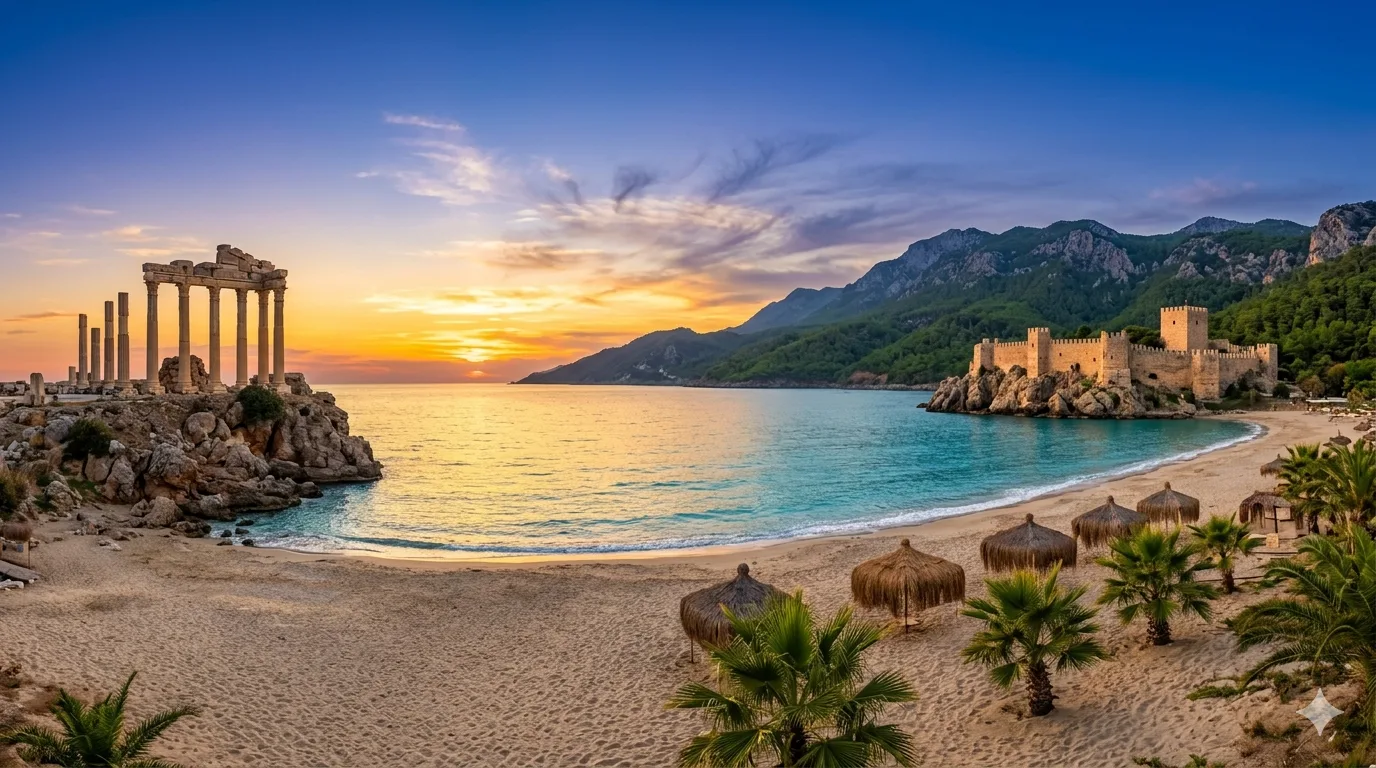
The Turkish Riviera attracts visitors with palm-fringed beaches, ancient ruins, and budget-friendly all-inclusive deals—ideal for family holidays with children.
The Turkish Riviera concentrates its attractions across three geographic clusters: Antalya in the west (modern city with historic quarter), Side in the east (ancient port town), and Belek in the south-central zone (resort area).
The Apollo Temple at Side is the region’s most visible ancient monument. The re-erected colonnade stands directly on the beach and dates from the 2nd century AD. Admission is free; the best photo angle comes from the harbor side at early evening.
Alanya Castle sits about 60 kilometers east of Side on a rocky promontory. The fortification is partly well-preserved; a panoramic walkway circumnavigates the installation in about two hours. The on-site museum documents Byzantine and late-medieval Ottoman history. The castle served as an Ottoman secondary palace—the strategic position overlooking the sea becomes apparent from above.
The Phosphorus Cave (Fosforlu Mağarası) is accessible only by boat, roughly 15 kilometers from Antalya or Side. The phenomenon: A natural rock opening whose interior walls glow via mineral deposits when sunlight enters. All boat-tour operators at the harbor know the route; the round-trip takes about three hours.
Damlataş Cave near Alanya is a stalactite-stalagmite formation over 15,000 years old. The cave has two levels and is accessible via footpaths. Note: Humidity is high and temperature consistently cool—a welcome relief during peak summer.
The Düden Waterfall lies 15 kilometers north of Antalya’s harbor and is road-accessible. The water cascades about 40 meters into a river basin. Boat tours from the harbor pass directly beneath it—water spray actually enters the boat.
The Kaleici Old Quarter in Antalya is the oldest harbor district. Narrow streets lined with stone facades, Ottoman and Seljuk facades, and minaret silhouettes form a pedestrian maze. Restaurants and cafés are abundant; prices are noticeably higher than in the outer city. The transition to the modern marina is seamless.
Karaalioglu Park spans 140,000 square meters south of the Old Quarter and houses a botanical collection of palms, agaves, and flowering plants. Footpaths navigate stairs and promenades; Mediterranean views are constant.
The Aspendos Theater sits about 40 kilometers east of Antalya near the town of Serik. Built in the 2nd century during Roman rule, it ranks among the world’s best-preserved examples of ancient theatrical architecture. The acoustics test is notorious—a coin dropped on the orchestra floor is audible from the stage. Practical: Opening hours are flexible (tickets around $7 USD / 340 TRY); the theater still hosts concerts.
The Manavgat Waterfalls are located roughly 40 kilometers from Side. A river valley with several cascading water tiers. Flow is year-round (mountain snowmelt feeds the source) but strongest in spring and early summer.
An all-day outing combining Alanya Castle + Damlataş Cave is a classic from Side. Transfer (minibus or rental car) takes 45 minutes; castle visit about two hours; cave roughly one hour. Essentials: sun protection, water, sturdy footwear for stairs.
Aspendos Theater + Manavgat Waterfalls pairs well (full day, 8 a.m. to 6 p.m.). Theater visit is brief (30–45 minutes); waterfalls require about one hour of walking. Many on-ground operators offer this package for $45–65 USD (approximately 2,180–3,150 TRY) per person, including transfers and lunch.
A Quad Safari into the Taurus Mountains departs from sites 40 kilometers west of Belek. The tour runs 3–4 hours over rocky woodland trails and typically concludes with lunch at a local family property. Cost: around $55–90 USD (approximately 2,670–4,365 TRY). Typical age requirement: 12+ for independent riding; younger children can ride with adults.
Boat tours to caves and the Blue Lagoon operate daily from Antalya or Side. The standard route visits two to three caves, includes a swim stop in a sheltered bay, and serves lunch aboard. Duration: 7–8 hours; cost: around $35–50 USD (approximately 1,700–2,425 TRY) per adult.
The Düden Waterfall is 20 minutes by car from Antalya and functions as a 90-minute stop rather than a full-day activity—worth combining before or after Old Quarter exploration.
Patara Beach lies west of the main tourist cluster, about 80 kilometers from Side (near Kalkan). The strand stretches 18 kilometers, is very fine-grained sand, and sees far fewer crowds than Lara or Belek. Caveat: Fewer beachfront restaurants; a drive to the nearest village is necessary. The beach is a loggerhead sea turtle nesting ground—night observation tours run in summer.
The Kekova Island Group (westward, near Kas) is a snorkeling hotspot with submerged Lycian ruins visible beneath the surface. Day tours from Kas (two hours by car from Side) enable underwater walking in shallow bays. Park entry fees run about $8 USD (approximately 388 TRY).
Lara Beach east of Antalya is quieter and more family-friendly than the crowded Konyaaltı to the west. Water is shallower, sand broader. Many family hotels cluster here. Public beach access points exist and are free; loungers and umbrellas rent for a fee.
A Tekke Waterfall hiking route near Belek is a local secret: roughly two kilometers of forest trail to a 15-meter waterfall in a narrow gorge. The trail is lightly marked; local guides (bookable through hotels) are recommended. Duration: 2–3 hours, free, though a small tip for guides is customary.
| Jan | Feb | Mar | Apr | May | Jun | Jul | Aug | Sep | Oct | Nov | Dec |
|---|---|---|---|---|---|---|---|---|---|---|---|
| Low | Low | Sweet Spot | Sweet Spot | Peak | Peak | Peak | Peak | Sweet Spot | Sweet Spot | Low | Low |
15° 8° | 16° 8° | 19° 10° | 24° 14° | 29° 19° | 34° 24° | 36° 27° | 35° 27° | 31° 23° | 26° 18° | 20° 13° | 16° 9° |
The high season (June to August) is viable for families but brings temperatures of 27–36 °C and massive tourist crowding. Beaches fill up, restaurants book solid, prices spike. The sea is ideal for swimming (28–29 °C), but breaks are necessary.
The sweet spot runs April to May and September to October. Temperatures fall between 14 and 31 °C; sea temperature ranges 20–28 °C (swimmable but not tropical); crowds are moderate. Rain is minimal but possible. Flights are cheaper than summer peaks. A beach vacation packing checklist helps with preparation for any season.
The low season (November to March) is budget-friendly and less crowded but brings rainfall (130–200 mm monthly average) and milder temperatures (8–20 °C). The sea is cold (16–18 °C), uncomfortable for most swimmers. Hiking and cultural visits are more pleasant.
Water is swimmable year-round starting June; peak conditions are June to October. Longer stays (3+ weeks) should target April or October—good weather aligns with school holiday breaks in many European regions.
Tea gardens (Çay Bahçeleri) dot every corner and are completely free. A glass of black tea (Çay) is ritual, not mere beverage. You sit, wait, sip. No payment is expected. The cultural logic: hospitality is assumed.
The Hamam (steam bath) is not coed. Women and men use separate areas. Visitors are scrubbed by a bath attendant—this is part of the service. Entry costs around $9–17 USD (approximately 440–825 TRY) plus a tip for staff.
Mosque visits welcome visitors but have rules: remove shoes outside, women wear a headscarf (often provided), visit outside the five daily prayer times. Photography is often prohibited.
Bazaar haggling is culturally expected. The opening price is merely negotiation’s starting point. Patience and a smile realistically reduce prices 20–30 %. The vendor’s stated price is the ceiling, not an offer.
Family and tranquility are central values. Large displays of affection (hugs, cheek-kisses among friends) are normal; children being loud in family restaurants is accepted; yet public couple displays are restrained. Restaurant tipping: 5–10 % is standard.
The southeastern border regions (Şanlıurfa, Mardin, Sırnak, Hakkâri) are operating zones for the PKK and Kurdish militant groups. The German Foreign Office advises against travel to these provinces. The Turkish Riviera is unaffected and lies roughly 1,000 kilometers away; the security situation is only relevant for overland trips into the southeast.
Drug possession carries 10–20 years imprisonment. Cannabis, heroin, cocaine—zero exceptions and no probation. Turkish justice recognizes no “medical grounds” leniency.
Photography of military installations is forbidden and taken seriously. Airports, naval facilities, barracks—all are protected. Tourists pleading ignorance may be taken to police.
Visiting crowded public spaces alone after dark increases pickpocket risk. Taxis are safer than walking. In tourist quarters the risk is low, but vigilance is routine.
The German Foreign Office warns of arbitrary detention of German citizens. Turkish authorities maintain lists of German-resident persons facing political or social media-based allegations. Even older posts can cause later problems. The recommended caution is not fearmongering—it is reality: in rare instances, German citizens have been denied exit from Turkey.
Antalya Airport lies approximately 40 kilometers east of the city and has good international connectivity. Flight time from Munich/Cologne: roughly 2–2.5 hours. The airport is modern; security screening is efficient. Transfers to downtown cost around $11–17 USD (approximately 535–825 TRY) by shuttle; rental car is uneconomical for short distances.
Dolmuş minibuses are the dominant local transport. Small buses run fixed routes, stop everywhere. Pricing is negotiable but typically $2–6 USD (approximately 100–290 TRY) for inter-city routes. Comfort is not guaranteed—the minibus stops when someone flags it and departs when enough seats fill.
Taxis are plentiful. Meters are standard, but negotiating is realistic. Uber/Bolt function in Antalya and larger towns. Pricing is more transparent and stable than traditional taxis.
A rental car costs around $22–45 USD per day (approximately 1,070–2,180 TRY) from airport pickup. EU licenses are sufficient; an international driving permit is not formally required but is recommended. Roads are in good condition; traffic aggression exceeds German norms. Full-coverage insurance makes sense.
A scooter rental is cheap ($6–12 USD/day, approximately 290–580 TRY) and popular for short trips. Helmets are legally required but enforcement varies. Insurance is minimal. Accident risk is elevated—traffic rules are guidelines, not laws.
Practical: Most family hotels arrange transfers and tours directly. All-inclusive resorts offer shuttles between sister properties.
German citizens require no visa for stays up to 90 days per 180-day period. This has been the rule since 2016. Previously, one could exit (overnight in Cyprus) and begin a fresh 90-day cycle—no longer possible.
The passport must be present and valid for at least 60 days beyond the intended departure. In practice: to avoid complications, the passport should have at least six months validity from the entry date. The national ID card is not sufficient—only a passport or passport-substitute document (e.g., emergency travel document) qualifies.
An e-visa is bookable online and costs around $20 USD (approximately 970 TRY). It’s needed for longer stays or re-entry after 90 days expire.
Border controls are routine. Passports are scanned; travel purposes are occasionally queried. Mobile devices may be searched—this is documented and sometimes exercised. When asked, explain your reason (holiday, family, culture).
Departure requires no exit scan, only flight check-in. Note: If you stay longer than 90 days and apply for a residence permit, this happens on-site (immigration office). The process takes 7–10 days.
Tap water is not potable. Bottled water is ubiquitous and costs around $1–2 USD (approximately 50–100 TRY) per liter. Many hotels/resorts provide water dispensers.
Routine vaccinations should be current (tetanus, diphtheria, polio, measles). Hepatitis A is recommended for extended trips or less-controlled settings. Malaria is not a coastal-region concern. Typhoid is optional depending on travel patterns.
Medical costs in private hospitals are significantly higher than in Germany—travel insurance with repatriation coverage is wise. Public hospitals are cheaper but less comfortable. Dental work is very inexpensive (50–70 % below German rates); many patients travel specifically for dental procedures.
Many medications are available without prescription (e.g., antibiotics, certain painkillers), which is both convenient and problematic.
The security situation is stable for the Riviera itself. Terrorist threats concentrate on southeastern border regions (not Antalya). An armed attack on the Israeli consulate in Istanbul in April 2026 shows that larger cities inherently carry some risk. The German Foreign Office recommends caution in crowded spaces; large gatherings should be avoided. On the tourist Riviera itself, day-to-day security is high—regular police presence, tourist infrastructure is protected.
Register your contact details with the German Embassy (Istanbul or via representation). In an emergency, contact can be established faster.
Which accommodation type makes financial sense for a beach holiday depends on travel style and duration. A comparison without hype.
Which European beaches truly welcome dogs, and what rules apply? A guide to the best beaches for a holiday with your four-legged companion.
Discover underrated European family destinations away from tourist crowds—with practical tips for school holidays, budgets, and mixed ages.
How to travel with teenagers without everyone hitting the breaking point – strategies for shared moments and necessary independence.