Travel Credit Cards: Fee-Free Withdrawals Worldwide
Comparison of top travel credit cards 2026 with fee-free cash withdrawals globally. Discover, Capital One, Wells Fargo and other tested models.
TravelFeelings Editorial Team
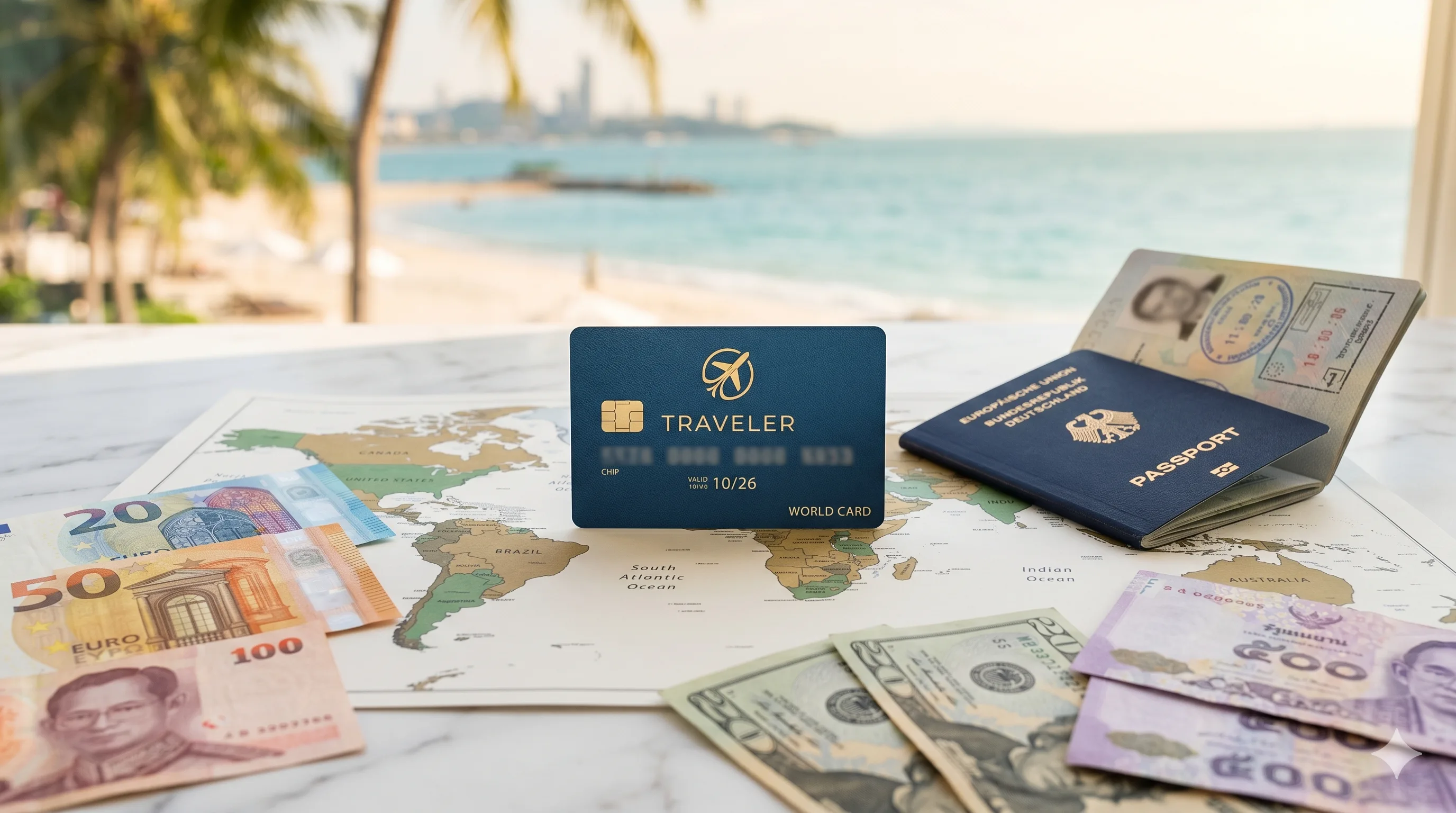
Money management on the road determines both security and financial efficiency. While many travelers still rely on cash and standard debit cards, the current testing landscape in 2026 makes one thing clear: specialized travel credit cards save substantial fees and offer protections that standard accounts cannot. Major US consumer testing organizations have analyzed eight common models in 2026. The results reveal not only the winners but also frequent beginner mistakes that cost travelers thousands of dollars annually.
Why the right travel credit card matters
A concrete calculation illustrates the gap. Traveling for two weeks in Southeast Asia with a standard domestic bank Visa card and using ATMs typically incurs 2 to 3 percent foreign exchange fees. Making five withdrawals of $100 each accumulates $10 to $15 in fees alone. With a specialized travel credit card, these charges vanish entirely. Over a full year of frequent travel (six trips), this represents $150 to $200 in pure savings. For regular travelers, the differential can exceed $300 annually.
Beyond fees, not all credit cards function equally abroad. The distinctions lie in fee structures, credit type (true credit vs. debit), and hidden costs like DCC traps that snare even experienced travelers.
The 2026 Testing Winners
Capital One Quicksilver: Zero Annual Fee, Broad Acceptance
Capital One’s Quicksilver card consistently ranks among the top no-annual-fee travel cards for US residents in 2026. It offers unlimited 1.5% cash back on all purchases, no foreign transaction fees, and is accepted everywhere Mastercard is honored globally. There is no annual fee — ever. The card delivers unlimited rewards regardless of spending category or purchase type.
The strength here is simplicity and universality. Capital One has one of the largest acceptance networks; the card works reliably in 195 countries. For travelers seeking a card that performs across categories (groceries, hotels, flights, taxis) without annual costs, Capital One Quicksilver deserves serious consideration.
Capital One Quicksilver at a glance:
- Annual fee: $0
- Foreign transaction fee: $0
- Cash back: 1.5% unlimited
- Card type: True credit card
- Acceptance: Mastercard global network
Discover it Miles: Unlimited Rewards Without Annual Fee
Discover often surprises American travelers: it has grown substantially beyond domestic US acceptance. Its Discover it Miles card offers unlimited 1.5X miles on all purchases, bonus miles on travel category spend, and — notably — Discover automatically matches all miles earned in year one. For a first-year traveler, this is 3% cash back equivalent on all spending. There is no annual fee.
The single caveat: Discover acceptance outside North America remains narrower than Visa/Mastercard. In Europe, parts of Asia, and Latin America, merchants accept Discover less frequently. However, this has improved markedly since 2024.
Discover it Miles:
- Annual fee: $0
- Foreign transaction fee: $0
- Rewards: 1.5X miles (3X first year via match)
- Network strength: Growing, but still narrower outside North America
Wells Fargo Autograph: Premium Features, No Annual Fee
Wells Fargo’s Autograph card bridges the gap between basic no-fee cards and premium offerings. It carries no annual fee, offers $200 in annual travel credit (hotels, flights, rental cars, taxis — very broad definition), and provides unlimited 3X points on travel and dining, 1X on everything else.
This card also includes trip cancellation insurance (up to $10,000 per person), trip delay reimbursement (meals and lodging if delayed 6+ hours), and lost luggage reimbursement (up to $2,500). These protections, while not comprehensive, reduce the need for expensive standalone travel insurance if you travel only occasionally.
Wells Fargo Autograph:
- Annual fee: $0
- Foreign transaction fee: $0
- Annual travel credit: $200
- Trip cancellation insurance: Yes (up to $10K)
- Card type: True credit card
Bank of America Travel Rewards: Simplicity and Points Flexibility
BofA’s Travel Rewards card is the entry-level option for travelers seeking simplicity. It charges no annual fee, offers unlimited 1.5 points per dollar on all purchases, and points redeem flexibly for any travel expense (flights, hotels, rental cars, local transit, parking). There is no foreign transaction fee.
The advantage: unlimited points without category restrictions. The disadvantage: points value (typically 0.66¢ per point) is lower than competitor offerings. This is the minimalist card — straightforward, affordable, and universal, but without bonus categories or travel insurance protections.
The Hidden Fee Trap: DCC (Dynamic Currency Conversion)
One issue consumer advocacy groups across the globe warn about explicitly: DCC, dynamic currency conversion. This trap costs international travelers hundreds of millions annually — often without awareness.
What is DCC? When withdrawing cash or paying with contactless at a foreign ATM or merchant terminal, the machine or terminal may offer to convert the amount into your home currency on screen. It sounds convenient — it is actually expensive. The ATM operator or payment processor does not use ECB reference rates but marks up the exchange by 3 to 10 percent. Accepting DCC means paying substantially more without any benefit.
The rule is simple: Always select “process in local currency” instead of the home-country conversion option. Your card issuer’s exchange rate (approximately USD 1 = EUR 0.87, June 2026) is fair and transparent.
A second trap is confusing credit card cash advances with ATM withdrawals. Cash advances incur 3 to 5 percent fees plus interest immediately — expensive. Use only the ATM withdrawal function on the cards listed above: those are fee-free.
Credit Card vs. Debit Card: Practical Differences Abroad
For hotel deposits and car rentals: hotels and rental agencies often require a true credit card, not debit. They verify available credit line, not just account balance — this protects them if damage occurs. A pure debit card (if you used one) may technically allow booking, but many merchants request cash deposits or reject it outright.
The practical recommendation is to carry two cards. A true credit card (Capital One Quicksilver or Wells Fargo Autograph) for hotel/car deposits and primary use. A second card as backup — if the first fails to read, is lost, or is blocked unexpectedly.
This redundancy costs one application but saves enormous hassle if a card fails abroad.
Annual Fee vs. No Fee: The Cost-Benefit Calculation
Several travel cards carry annual fees (American Express Premium, Citi Prestige). The question is whether benefits justify the cost. For most leisure travelers making 3 to 5 trips yearly, zero-fee options (Quicksilver, Wells Fargo Autograph, Discover it Miles) offer sufficient benefits without the annual drag.
Calculate your own: If you spend $3,000 on a two-week trip, Quicksilver earns $45 in cash back (1.5%). Wells Fargo Autograph earns approximately $90 in points (3X on travel), which redeems at $0.70 per point = $63 in travel value. Even modest spending quickly covers annual fees and generates profit — but only if you travel frequently.
For occasional travelers (once annually or less), a no-fee card is optimal.
International Travel: Insurance Coverage Beyond the Card
Some travel credit cards bundle insurance; others do not. Here is the reality:
Cards with integrated travel insurance:
- Wells Fargo Autograph (trip cancellation, trip delay, luggage)
- American Express Premium/Centurion (comprehensive, but high annual fees)
- Select Visa Infinite cards (varies by issuer)
Cards without integrated insurance:
- Capital One Quicksilver
- Discover it Miles
- Bank of America Travel Rewards
Recommended: For cards without bundled insurance, consider supplemental trip cancellation insurance ($20–$40 per trip) if you book non-refundable hotels or flights. The cost is low; the peace of mind is high.
Practical Checklist Before Departure
- Two cards in different wallets: Never carry all payment methods in the same bag — if one is lost or stolen, you have a backup
- Notify issuer of travel: A call to your card’s fraud team prevents blocks when cards are used abroad
- Memorize primary card PIN: You must be able to withdraw cash even if your phone is dead
- Store copies separately: Card numbers (never CVV!) photographed and stored in your email or a separate location
- Check daily withdrawal limits: Many issuers cap ATM withdrawals at $500–$1,000 daily
- Reject DCC every time: If an ATM offers conversion, decline. Your card issuer’s rate is fair; the ATM operator’s is not
- Activate cards before travel: Some issuers flag new card activations as fraud unless you authorize first
Choosing Your Card
The best travel credit card is free (Capital One Quicksilver, Discover it Miles, Wells Fargo Autograph), charges no foreign fees, supports worldwide ATM access, and functions without hidden costs. For most US travelers, Capital One Quicksilver stands out as the top choice: true credit status, broad acceptance, unlimited rewards, and zero annual costs.
Frequent travelers who value trip insurance should consider Wells Fargo Autograph. Those prioritizing simplicity and flexibility should consider Bank of America Travel Rewards.
The real value comes less from the card than from how you use it. Rejecting DCC consistently, carrying two cards, and knowing the difference between cash advances and ATM withdrawals — these habits generate the actual savings. You can control card fees; a careless payment abroad can cost far more.
Editorial disclosure: this article may include affiliate links; recommendations are independent of any compensation.