Flying With Kids: Seats, Entertainment, Snacks
Practical tips for calm flights with kids — from seat selection strategies to proven entertainment and snacks.
TravelFeelings Editorial Team
Most travel articles paint a dreamy picture of long-haul flights where children peacefully doze for hours. The reality looks different: the older child hits a restlessness wall around hour four, the younger one needs an emergency toilet break after roughly five hours, followed by boredom protests. Not catastrophic, just real. The trick isn’t preventing it — that’s fantasy — but handling it steadily. A large notebook, good headphones, a surprise box of unknown trinkets. The mental shift — this will be tough and that’s fine — takes the edge off the whole thing.
It’s tempting to believe that good planning prevents chaos. In practice it does something better: it makes chaos manageable. Across families who fly with young children, the biggest stress doesn’t happen at 35,000 feet — it happens at the booking screen and the week before departure. If you choose seats strategically, pack entertainment thoughtfully, and organize snacks systematically, you won’t just fly more calmly. Your children will too. Here are the most concrete tips for intensive family travel.
Booking Seats — Strategy by Child’s Age
The first thing you should do after buying your tickets is reserve seats. Good news if you’re flying within the EU: as of 2026, airlines are required to seat children under 14 adjacent to an accompanying adult at no extra charge. This is a genuine win for families — though if you’re flying to or from outside the EU, older policies may still apply. Even with free family seating rules, booking early helps secure the best positions in your cabin section.
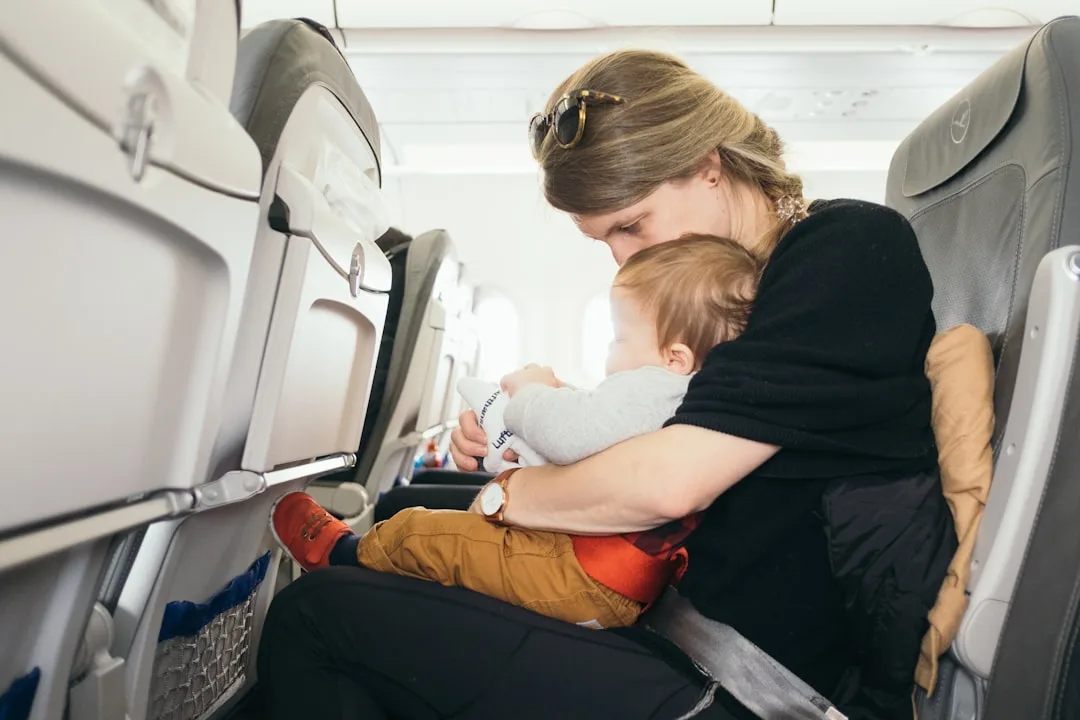
To be honest: a child under two can sit on your lap for short flights, but for anything over five hours, buy them their own seat. Infants under two fly best in the bulkhead row on wide-body aircraft (Boeing 777, Airbus 350) — that’s where airlines mount bassinets directly to the wall. This isn’t luxury; it’s practical necessity. Your baby doesn’t need to be held constantly, and they sleep horizontally instead of wedged against the window.
For toddlers between two and four, one pattern works reliably: window seat for the child, middle seat for one parent, aisle seat for the other. This prevents your child from bolting sideways, gives the aisle parent quick access (critical for emergency bathroom runs with a not-yet-toilet-trained child), and the window entertains your child far longer than you’d expect — shade games, counting clouds, tracking the wing’s position relative to clouds below.
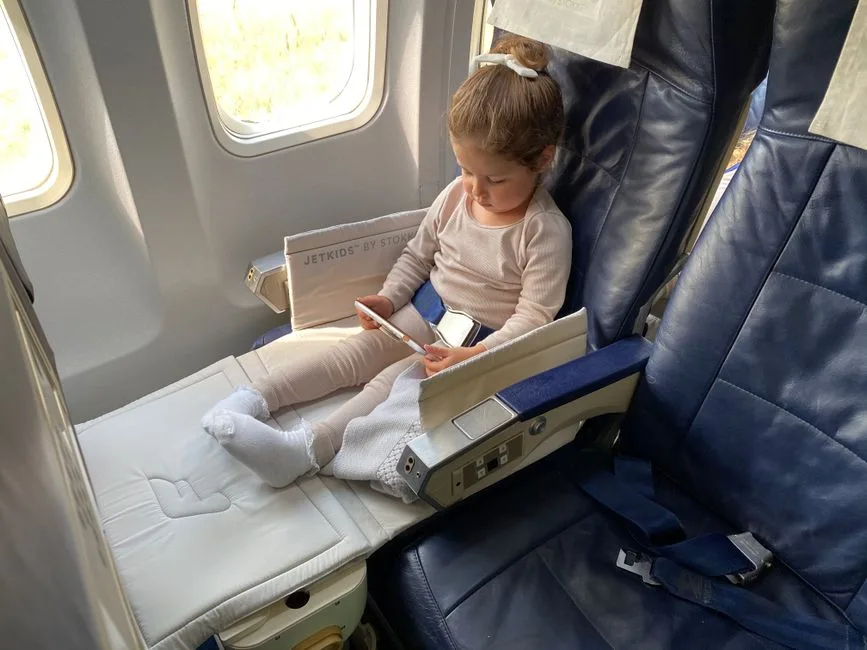
School-age children from five onward need a seat with a working seatback screen and, ideally, power for their tablet. Window seats still help with sleeping, though at this age many children care more about entertainment than views. This sounds dramatic but isn’t — many flights have enough empty seats that your preferred cabin has only two seats booked.
Watch out for these mistakes: exit rows (children are prohibited), the very last row (loud bathrooms, no seat recline, lights on all night), and seats directly adjacent to galleys or lavatories. Over-wing seats (typically rows 13–17 on long-haul flights) are surprisingly the smoothest zone — your child won’t be bounced around as much during turbulence.
Entertainment — Rotation Is Everything
Here’s where it gets practical: your child will concentrate on a tablet for 90 minutes, but only if they haven’t touched one in six months. Don’t pack every toy your child has ever loved. Pack instead a mix of trusted favorites and completely unknown surprises.
The best strategy is activity rotation every 15 to 20 minutes. Sticker book for 15 minutes, then a five-minute snack break, then a travel magnetic puzzle, then a song on headphones, then ten minutes of tablet time. Psychologically, this feels like adventure rather than endurance.
For babies and infants under three, pack: teething rings (especially important during cabin pressure changes at takeoff and landing), grabbing rattles, soft crinkly paper (lots of it), classic board books, and a large scarf or blanket that both of you can hide under if cabin lighting stresses your child. Window shades are surprisingly entertaining for small children — up-down-up-down can kill 20 minutes you didn’t think you had.
For preschoolers and early school children (three to six years), sticker books, drawing tablets with styluses, travel magnetic games, and a tablet with downloaded cartoon episodes form the backbone. Coloring and activity books sound good until you watch your child break crayons, smudge their clothes, and create debris everywhere. Think bigger: cheap plastic trays from discount stores, filled with magnetic letters or modeling clay — your child gets a craft experience without the crumb catastrophe.
For older school-age children (six to twelve years), fully charged tablets with good headphones and a backup battery pack are your foundation. Bring an external power bank — the flight outlasts the battery. A large notebook and quality pencils (Faber-Castell or Staedtler) work surprisingly well: many children would rather draw or write than watch screens. Card games like Rummy or dice games take minimal space and can occupy two adults and a child for three hours. Test headphones before you board so your child doesn’t develop ear pressure discomfort mid-flight.
The most important thing: pack two or three genuinely new items your child has never seen before. A cheap book from the toy store, a new blind box surprise, a sticker book with unfamiliar designs. These new stimuli hold attention far longer than familiar toys — psychologically, “new” feels like a mini-adventure.
Snacks and Food — The Double-Supply Rule
Here’s the thing: pack twice as many snacks as you think your child will need. Flying makes kids hungry. Hunger makes them moody. Moody children are the opposite of calm. If you’re planning beach vacations or longer journeys, this snack strategy is your lifeline.
The gold-standard snacks are ones that help with cabin pressure changes and don’t scatter crumbs everywhere. Cheese puffs (brands like Pirate’s Booty or store brands), veggie straws, mini pretzels, and corn cereal are ideal: they dissolve in the mouth, require no drink to swallow, and create zero crumb tsunami in the cabin. Dried mangoes, apple rings, and small raisins (in individual portions, not a bulk bag) provide sweetness without sugar crashes.
Include protein snacks too: cheese sticks, hard-boiled eggs (yes, it sounds odd, but eggs don’t spoil and many kids eat them anyway), beef jerky pieces, and mini granola bars with real butter instead of corn syrup. Protein keeps your child fuller longer and prevents the notorious two-hour hunger spiral.
Here’s the practical part: TSA and EU regulations allow solid food in carry-on luggage. If it’s hard, dry, and not spreadable, it goes through. Avoid open yogurt cups, nut butters in jars, chocolate bars (they melt), whole grapes or cherry tomatoes (choking risk during turbulence), hard candies, and anything with intense smell like tuna sandwiches. Your child won’t starve, but neither will your neighbors want tuna aroma at 3 a.m.
Airlines provide meals, but honestly: on European short and medium-haul flights they taste like cardboard. Long-haul meals are better, but not good enough that a picky four-year-old will eat them. Pack something your child actually wants — their favorite cereal in an airtight container, beloved crackers, a preferred spread. This avoids the meal-time battle.
One last tip: bring an empty water bottle through security and fill it at a water fountain. Airplane water tastes like airplane. Your child drinks more from their favorite bottle. Dehydration worsens jet lag and headaches — hydration is underrated.
Packing — The Layering Method
This sounds methodical, but it works: organize your carry-on in layers matching when you’ll need things.
Top layer: boarding pass, travel documents, first snacks, a change of clothes for your child (yes, accident risk), diapers, and wipes.
Middle layer: entertainment battery pack, headphones, tablets, books and coloring supplies, surprise trinkets.
Bottom layer: backup snacks, medications (fever reducer, teething relief), a warm sweatshirt for your child (planes are cold), a thin scarf or baby blanket.
This prevents the 2 a.m. situation where you’re frantically searching for diapers under the cabin lights while your child melts down.
Airline Tips and Little Secrets
When flying with children, booking the right seat at the right time matters. Most airlines prioritize family seating now, though the exact policies vary. Book your seats immediately after buying your flights — not at check-in.
If you’re traveling with a stroller, gate-check it just before boarding (not at bag drop). You’ll need it for your child during boarding and can retrieve it immediately before the door closes.
One insider tip: if you’re flying multiple times in one week (arrival flight, then car rental, then connection flight), book all flights from the same airline in the same booking. Some carriers offer family discounts on multiple flights within a week.
To be honest: keeping your child calm isn’t entirely in your control. A sick child won’t sleep. An overstimulated child won’t sleep. A child who hates the new time zone won’t sleep. That’s okay. Your job isn’t to sedate your child (legally or otherwise) but to steadily guide them through five, eight, or twelve hours with patience and minimal catastrophism. With a big book, good headphones, and a surprise box.
Flying with kids isn’t pleasant. It’s manageable. And that distinction changes everything. For more family travel strategies and destination guides, explore our full collection of resources for traveling with children.