Review
All-Inclusive vs. Self-Catering: Which Booking Model Fits?
Which accommodation type makes financial sense for a beach holiday depends on travel style and duration. A comparison without hype.
TravelFeelings Editorial Team7 min.
Germany · East Frisia, North Frisia
The North Sea coast pairs miles of sandy beaches, car-free islands, and the UNESCO Wadden Sea—an affordable, authentic family escape without the crowds.
Sylt is Germany’s largest North Sea island, spanning nearly 100 square kilometers. The island offers 40 kilometers of beach with approximately 12,000 beach chairs—a distinctly German sight. Infrastructure caters to upscale travelers, but families also find affordable options on the windier eastern side. Access is via the Hindenburgdamm by train or car; a rental vehicle on the island is unnecessary.
Föhr is the family-friendly alternative: 15 kilometers of white sandy beach, shallow calm water perfect for children, and a cycling network covering the entire island. A bike tour around the island takes three hours. Five functional windmills document the region’s agricultural heritage. Ferries depart tide-bound (not by schedule!) from Dagebüll. Those comparing sibling destinations will find similar family-travel conditions at the Baltic Sea.
Amrum offers the Kniepsand—a 15-kilometer sandy beach, three kilometers wide in places. This ranks among Europe’s largest continuous sandy beaches and is particularly worthwhile during low season. The interior is forested with walking trails; the bird sanctuary on the eastern side attracts nature enthusiasts year-round.
Norderney and Borkum are the eastern East Frisian islands, accessible by ferry from Norddeich (90 minutes sailing) and Emden. Both islands are larger than western counterparts and offer more urban amenities. Borkum, the westernmost inhabited German North Sea island, was historically a duty-free zone—that heritage remains palpable. Norderney features developed wellness infrastructure and appeals to older travelers.
Helgoland is a high-sea island and bird paradise with sandstone cliffs reaching 61 meters. Day trips by ship from Cuxhaven are available (approximately 90 minutes sailing). The small red rock is famous among birdwatchers for good reason.
St. Peter-Ording is the mainland highlight: known for its Pfahlbauten (elevated beach pavilions), endless sandy beaches, and wellness facilities. The resort is also Germany’s center for wind and kite surfing. Summer months draw crowds, however.
The Wadden Sea is an 11,500-square-kilometer tidal zone spanning Denmark, Germany, and the Netherlands. Twice daily the tide recedes, revealing an otherworldly landscape of mud, sand, and shallow water channels. This UNESCO World Natural Heritage site teems with life—seabirds, harbor seals, mussels, and oysters. The North Sea cannot be understood without the Wadden Sea.
Island-hopping: Multiple-island itineraries work best with a base on Föhr and day excursions to Amrum (45-minute ferry). Alternatively, visit three or four islands in a week starting from Dagebüll.
Cuxhaven seal banks: Cutter trips from Cuxhaven reveal exposed sandbars where harbor seals and grey seals rest. Excursions last two to three hours and suit young children. Cuxhaven itself is a classic harbor town with cafés and Ritzebüttel Castle.
Halligen tours: The Halligen are exceptional tidal islets—tiny, car-free islands without dikes, flooded during storm surge. Hallig Hooge and Hallig Gröde are accessible and offer nature experiences for adventurous families. Bicycles serve as primary transport.
Husum: Theodor Storm’s “gray city by the sea” lies 30–40 kilometers south and suits a half-day excursion. The tidal harbor sits in the town center, Husum Castle warrants a visit, and the old town invites coffee and cake.
Jaderpark and Moormuseum: The Moormuseum documents traditional East Frisian life. Jaderpark was an open-air museum; its concept is under revision—verify opening hours beforehand.
Spiekeroog is a small East Frisian island with approximately 900 residents and functions as a car-free island. Ferries depart from Neuharlingersiel (approximately 45 minutes). The beach feels quieter than Norderney, with fewer tourist facilities but more tranquility.
Büsum is a harbor town on western Schleswig-Holstein’s North Sea coast, overlooked because Sylt and St. Peter-Ording dominate conversation. Local fishing culture thrives; the Meereswelten aquarium showcases North Sea fauna; ferries to the Halligen operate regularly. Tourism remains less intense than at mainstream resorts.
Langeoog is the next eastern island after Spiekeroog and equally peaceful. The Pirate Skeleton Museum and National Park House offer insights into tidal ecology. Conservation here is earnest—dunes receive strict protection.
Wenningstedt-Braderup on Sylt: Those preferring to avoid Sylt’s luxury scene retreat to this northern settlement—less glamorous, more residential character.
| Jan | Feb | Mar | Apr | May | Jun | Jul | Aug | Sep | Oct | Nov | Dec |
|---|---|---|---|---|---|---|---|---|---|---|---|
| Low | Low | Low | Sweet Spot | Sweet Spot | Peak | Peak | Peak | Sweet Spot | Low | Low | Low |
5° 1° | 6° 1° | 8° 3° | 13° 6° | 17° 10° | 20° 14° | 22° 16° | 22° 16° | 18° 13° | 13° 10° | 8° 5° | 5° 2° |
April to May: Weather turns mild (6–17 degrees Celsius); occasional warm spells arrive. School holidays haven’t begun, so prices stay low and beaches remain uncrowded. Mudflat hikes are pleasant—the mud isn’t frigid. Those preparing for beach holidays find practical packing lists and tips elsewhere on our site.
June to August: Peak season. Temperatures climb to 20–22 degrees; water reaches 20 degrees and becomes swimmable. The sun sets around 21:00; daylight is extensive. However, accommodations cost more and beaches fill. Families on school holidays have no alternatives—July and August are firmly peak season.
September to October: Indian summer appears on the North Sea. Temperatures drop to 18–13 degrees, but air clarity improves, bird migration activates, and hotels return to reasonable rates. This is optimal for childless adults.
November to January: Winter storms dominate; water freezes (2–6 degrees), yet a raw romance prevails. Christmas markets operate in Husum and Sylt. Swimming is off-limits, but walking and restoration are possible. Prices hit annual lows.
February to March: Weather stays gray and cold, though early spring signs emerge. Not ideal for beach holidays, yet nature enthusiasts value the birdwatching.
East Frisian tea culture: This is not English afternoon tea. East Frisian tea is a rigid ceremony: strong black tea (Germany’s strongest), served in porcelain bowls, with a sugar cube (Kluntje) over which hot tea is poured. The sugar cracks distinctly. Next, a drop of cream is added (not stirred). Local tea rooms offer this—it’s become touristy, but for East Frisians it’s serious business.
Low German and Frisian language: In fishing villages and smaller towns, Low German persists—a Low Saxon dialect island. Tourists hear it in harbor taverns and from elderly locals. Frisian is a distinct language with one million global speakers; in Germany it’s restricted to coastal regions. Both contribute to local identity.
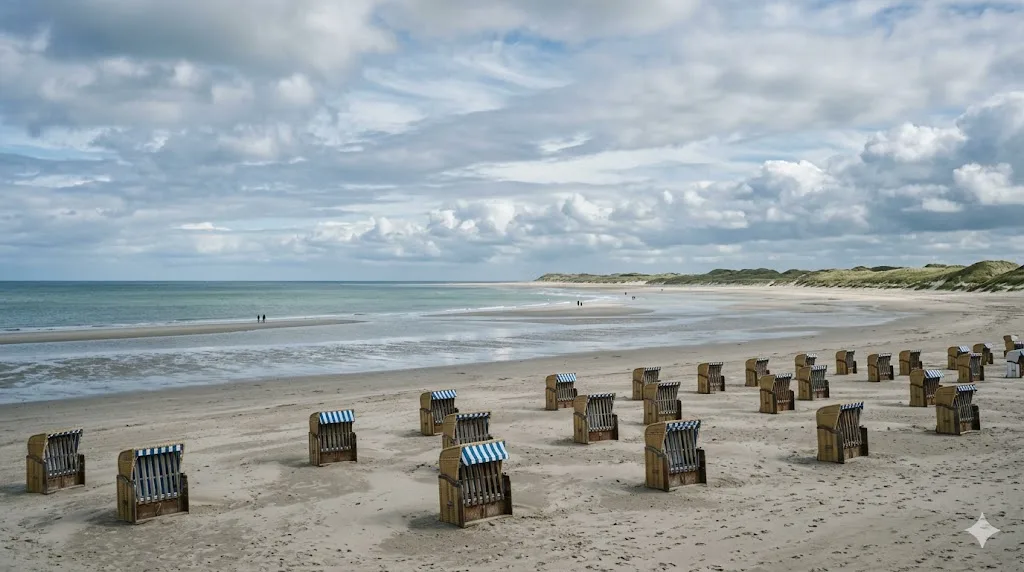
Beach chairs: The striped beach chairs (red-white or blue-white, individually painted) have become cultural icons. Each has a number and reserved spot. Beach-chair rental is a significant profession on the North Sea—over 12,000 chairs stand on Sylt alone. This is quintessentially German and rightfully branded.
Traditional dress: At folk festivals and church celebrations, local women’s traditional costumes appear—white bonnets with gold embroidery, colorful skirts, black aprons. This is lived history, not tourist theater.
Wadden Sea reverence: The Wadden Sea has given the region a natural teacher—respect for tides, natural forces, and humility. Locals call this reverence for the sea. Early storms have shaped mentality.
Mudflat hiking without a guide: This is life-threatening. The Prielen (deep water channels in the mud) are invisible from above. Incoming tide moves faster than walking pace—speed reaches 1.5 meters per minute. Always book a certified mudflat hiking tour. Local guides know safe routes. Media reports of drowned hikers are tragic and avoidable.
Underestimating storm season (November–January): The sea turns wild; waves reach 4–5 meters; beaches sometimes close to swimmers; wind gusts hit 60+ km/h. Beach walking is acceptable; swimming is deadly. Hotels signal warnings; local newspapers alert in advance.
Ignoring jellyfish: Summer months (July–September) can bring jellyfish swarms. They’re annoying rather than life-threatening, but nematocysts sting. Vinegar seawater is the remedy—most beaches stock vinegar. Flags signal jellyfish presence.
Ignoring tides: Ferries operate only during flood tide. Timetables are averages—actual departure times can shift 30 minutes earlier or later. Every island and harbor town posts tide charts. This is non-negotiable.
Collecting shells and seahorses: The Wadden Sea is protected. Gathering shells, snails, and seahorses follows regulations. Small quantities for personal use are often acceptable; larger quantities are prosecuted. Check national park rules beforehand.
Driving: The German North Sea is accessible from Hamburg (120 km south) or Bremen (140 km). From Kiel/Hamburg, take the A1 south to Bad Segeberg, then B206/B432 to the coast. Driving time is 2–3 hours. Parking is expensive during peak season (about $11–16, approx. €10–15 daily; as of July 2026).
Rail: ICE trains reach Hamburg; from there regional trains go to Husum (2.5 hours from Hamburg), Sylt via the Hindenburgdamm (4 hours from Hamburg, cars transported), and Cuxhaven (3.5 hours from Hamburg). Rail is eco-friendly and stress-free but pricier than driving (especially for families).
Island ferries: Ferries are tide-bound. They don’t follow timetables—they follow tides. A schedule is an average; actual departures may vary 30 minutes earlier or later. Key ports include:
On-island: Cars are unnecessary on most islands and prohibited on some (Spiekeroog, Langeoog). Bicycles are ideal. The North Sea Coast Cycle Route connects Denmark, Germany, and the Netherlands—1,200 kilometers, 500 km in Germany. The route is flat and family-friendly (elevation gain under 50 m over long stretches).
Public transit: Trains and buses are cheap with regional tickets (e.g., Schleswig-Holstein ticket, about $38 / approx. €35 for up to 5 people one day). Family beach destinations like the North Sea benefit from affordable access without flying.
German citizens need no visa—the North Sea is Germany. A valid passport or ID card suffices. EU/EEA and Swiss residents enjoy the same terms.
Passports must remain valid for at least 3 months after departure. This is EU standard, including for German citizens traveling onward.
Pets require EU pet passports and current vaccinations (rabies).
Customs matters are moot—the North Sea is a domestic destination.
Travel insurance isn’t mandatory but worth considering: vacation rental cancellation fees can be substantial, and short-notice medical issues (toothache, stomach upset) abroad are covered by some policies. Domestic travel insurance makes less sense.
Mudflat-hiking safety: This is paramount. Only go with certified guides. Prielen are deadly traps—rescue is often impossible once tide comes. Local guides know exact tide times and safe routes. Water temperature runs 16–20 degrees in summer, below 5 degrees in winter—heat loss is rapid.
Bathing water quality: North Sea beaches undergo regular monitoring. Water quality is good; bathing bans are rare and communicated. Jellyfish appear but aren’t life-threatening—vinegar baths help.
Sun protection: Beaches reflect strongly. Sun feels more intense because water and sand amplify UV. SPF 50+ sunscreen is mandatory; head coverings are wise.
Allergy info: Marine air carries high iodine. Asthmatic and sensitive-airway individuals may experience irritation. Inhalant bronchitis occasionally occurs—respiratory masks in worst cases.
Tap water: Drinking water is excellent quality. Direct tap consumption is safe—no filtration needed.
Infectious diseases: No vaccinations beyond German standards are recommended for the North Sea. Hepatitis A and typhoid pose no risk.
First aid: Lifeguards staff busy beaches in summer. Emergency apps and defibrillator locations are marked. Nearest pharmacies and clinics are 5–10 minutes away in coastal towns.
Which accommodation type makes financial sense for a beach holiday depends on travel style and duration. A comparison without hype.
Which European beaches truly welcome dogs, and what rules apply? A guide to the best beaches for a holiday with your four-legged companion.
Discover underrated European family destinations away from tourist crowds—with practical tips for school holidays, budgets, and mixed ages.
How to travel with teenagers without everyone hitting the breaking point – strategies for shared moments and necessary independence.