The Best Boutique and Luxury Hotels in Tuscany
Four luxury hotels in Tuscany with genuine craft instead of marketing. Castiglion del Bosco, Monteverdi, Borgo Santo Pietro, and Adler Thermae.
TravelFeelings Editorial Team
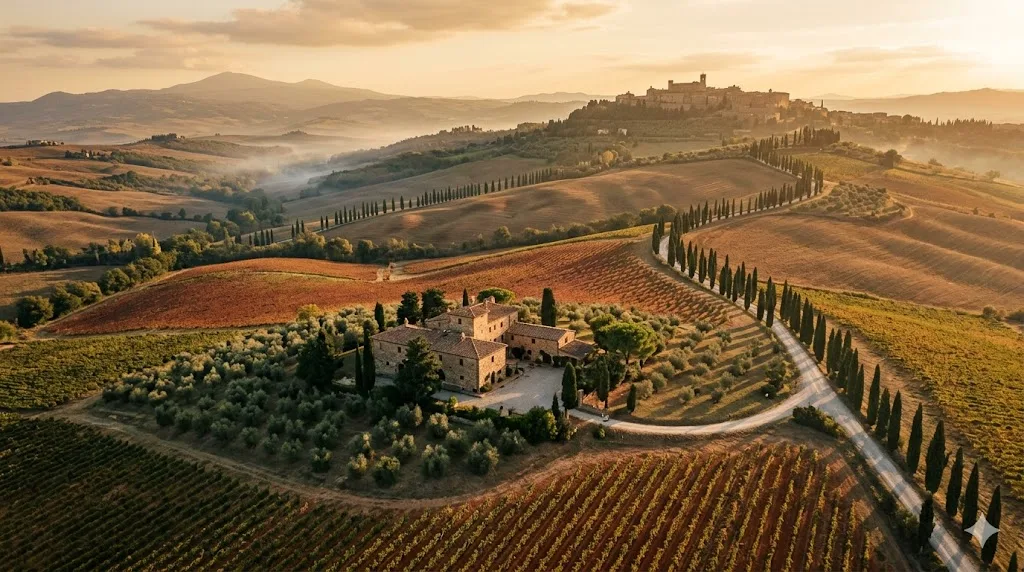
Staying in Tuscany requires distinguishing between two quality levels: hotels that call themselves boutique because they have fewer than 100 rooms, and properties that actually follow a distinct design philosophy. The distinction is difficult because the marketing language is identical — all promise authenticity, all boast about local products, all describe the owner as a collector with taste. And yet this is precisely where craft reveals itself. A genuine hotel is recognizable by the limits it sets, not by offering everything.
Tuscany has never been an affordable destination. But it has long become a navigable one: Florence and Siena are overrun by mass tourism, the Chianti and Val d’Orcia wine regions have transformed into design hotels. Whoever travels to Italy and values genuine quality needs to know where to go. These four properties differ significantly.
Castiglion del Bosco: The Craft of Authenticity
Rosewood’s flagship in southern Tuscany sits on 5,000 acres with its own vineyards, a private golf course (the only one in Italy not open to the public), and the remains of a 17th-century castle. 42 suites and 11 villas are distributed across the estate — some in restored 17th-century farmhouses, some in modern design, but all built with the same logic: windows facing the vineyard, not the neighboring hotel.
What makes it special is not the scale, but the consistency. The Campo del Drago restaurant earned its Michelin star legitimately — it serves no molecular cuisine, but Brunello-region classics with precision. Suites start at around $300 per night (€280), villas reach up to $2,700 (€2,500) — every price is comprehensible, not inflated. The staff understands that guests are here for tranquility, not to be waited upon.
The design DNA: reductive. Not minimalist in the Instagram sense, but reductive in the craft sense — only what is necessary is present, and it is done well.
Monteverdi: Storytelling as Strategy
In Val d’Orcia, in a medieval hilltop village called Castiglioncello del Trinoro, a German family named Lüde operates a different concept. 31 rooms plus three private villas, but everything is narrated, not merely furnished. Each room has a name, a story. The Oreade and Zita restaurants are not just kitchens but theatrical art — refined, sometimes excessive, but authentic.
Monteverdi is the most expensive property in this selection: $378–$756 per night (€350–700) for standard rooms, more for the villas. That is not by chance. The Lüdes have built a complete ecosystem: a Culinary Academy, art and music events, a spa with a scientific orientation (treatments with medical specialists). Staying here means buying an experience, not a room.
That is not lesser quality than Castiglion del Bosco — it is different. Those seeking tranquility go to the Rosewood castle estate. Those wanting cultural immersion stay here.
Relais Borgo Santo Pietro: The Farm-to-Table Model
In Radda in Chianti, in one of Italy’s finest wine sub-regions, stands a 13th-century palazzo with 22 rooms and a 300-acre organic farm. This is not decoration — the farm functions. There is a dairy producing sheep’s cheese daily, a beehive, orchards, cattle. The Meo Modo restaurant holds a Michelin star because the kitchen genuinely has access to the raw ingredients it needs — not because a celebrity chef was engaged.
The 22 rooms are all different, all furnished with antiques, all without false kitsch. $302–$594 per night (€280–550). That is less expensive than Monteverdi, more expensive than Castiglion del Bosco, but the price is fair because you know where your food comes from.
The farm-to-table model is a worn-out marketing phrase. Here it is substantive. Whoever wants to distinguish genuine sustainability from craft should book a room and visit the dairy.
Adler Thermae: Wellness as Space
Not all luxury architecture in Tuscany is built around old stones. Adler Thermae, in San Quirico d’Orcia in the Val d’Orcia, is a modern wellness resort with expansive thermal pools — water from the natural spring of Bagno Vignoni, 50 degrees Celsius at the source, regulated to 36 degrees in the pool.
This property is not built for maximum tranquility. It is built for activity: trekking, cooking classes, wine tastings, spa treatments. $216–$486 per night (€200–450). That is the budget entry point to Tuscan luxury, but not cheaply made — the bioclimatic rooms have genuine wellness technology, not just the words.
Adler is ideal if you are planning six days in Tuscany and want to spend three of them relaxing, not thinking.
| aspect | castiglion | monteverdi | borgo | adler |
|---|---|---|---|---|
| Design Philosophy | Castle architecture, reductive | Storytelling, theatrical | Farm integration, substantive | Wellness focus, modular |
| Price (per night) | $300–$648 (€280–600) | $378–$756 (€350–700) | $302–$594 (€280–550) | $216–$486 (€200–450) |
| Region | Montalcino (Brunello) | Val d'Orcia | Chianti (Radda) | Val d'Orcia |
| Michelin Restaurant | Yes (Campo del Drago) | Yes (Oreade) | Yes (Meo Modo) | No (wellness focus) |
| Best for | Wine + tranquility | Culture + experience | Farm craft + design | Wellness + activity |
Distinguishing Craft from Marketing
Luxury hotels all advertise authenticity. That is meaningless — you need to know which promises have genuine systems behind them.
Check whether the hotel has its own production. Sheep’s cheese from the farm (Borgo), wines from its own vineyard (Castiglion), thermal water from its own springs (Adler) — these are not gimmicks, they are quality anchors. Marketing cannot fake them. When you sit in the restaurant eating cheese, you know whether it was made 15 kilometers away or came from a supplier catalog.
Staff is an indicator. Large hotels have concierge theater. Small hotels have employees who know where the nearest farmers’ market is and when the cheesemaker works. Ask for specifics — not “tips for guests,” but “When does the dairy open?” and “Who is the cellar master?” The answers reveal more than brochures.
Regional Orientation: Chianti vs. Val d’Orcia
Tuscany is not homogeneous. Chianti (Radda, Greve) is a wine culture destination with established design. Val d’Orcia is a nature park with a wellness focus. Montalcino is castle country with Brunello wine prestige. Luxury travel in the region differs considerably depending on this context.
Chianti → Relais Borgo Santo Pietro, if you want design + wine Val d’Orcia → Monteverdi, if you want culture + immersion; Adler, if you prioritize wellness Brunello zone → Castiglion del Bosco, if you want private tranquility + golf
The best travel season is April–June and September–October. July–August is too hot and too crowded. December–February is too cold and too wet. May and October are ideal — the vines are flourishing, swimming is possible, hotels still have capacity.
Sustainability Certification: Genuine vs. Greenwashing
One important point: not all certificates imply substance. Relais Borgo Santo Pietro operates an organically certified farm — you can verify that. Castiglion del Bosco is LEED-certified and holds a Michelin Green Star rating. This means: these hotels have had to meet external standards, not just make internal claims.
Monteverdi and Adler have sustainability narratives but fewer external certifications. That does not mean they are not sustainable — it means you will need to verify yourself. Ask about water recycling, local supply chains, energy sources.
Greenwashing is common: “We use regional vegetables” is not sustainable if delivery is by car. A genuine standard is: the vegetables grow 3 miles away, delivered daily by bicycle. Ask for details.
When Which Hotel Makes Sense
- Castiglion del Bosco: If you are staying 7+ nights and want tranquility, golf, and wine in a setting that is not performance.
- Monteverdi: If you have 5–7 nights and want cultural experience, restaurants, events — and the budget is higher.
- Relais Borgo Santo Pietro: If you want design + genuine sustainable craft and are staying 4–5 nights.
- Adler Thermae: If you have 3–4 nights and want to combine wellness + activity, trekking + spa.
The first experience with luxury hotels is often an overview. The second trip goes deeper. Whoever realizes that Tuscany is a genuine cultural landscape, not a museum for tourists, plans longer.
Reservation Mode
All four hotels are members of Relais & Châteaux or Virtuoso (where applicable). This means: direct booking is always better than platforms, but also that you can use your travel consortium if you have one — sometimes there are upgrades or additional services.
The key is not the price, but the contact. A conversation with the head concierge tells you whether you are welcome there. Do not book blind.
Tuscany is not a mystical place. It is a region with a concrete craft tradition that is increasingly overrun. Whoever seeks a genuine hotel does not need more hotels in the hills, but fewer — and better ones. These four are not perfect. But they are consistent: what they promise is not marketing, but systems.