Guide
Autumn City Breaks: European Gems Away from the Crowds
Discover Europe's cities in autumn without crowds. Architectural masterpieces and hidden gems for the culturally curious traveler.
TravelFeelings Editorial Team10 min.
Czech Republic · Central Europe
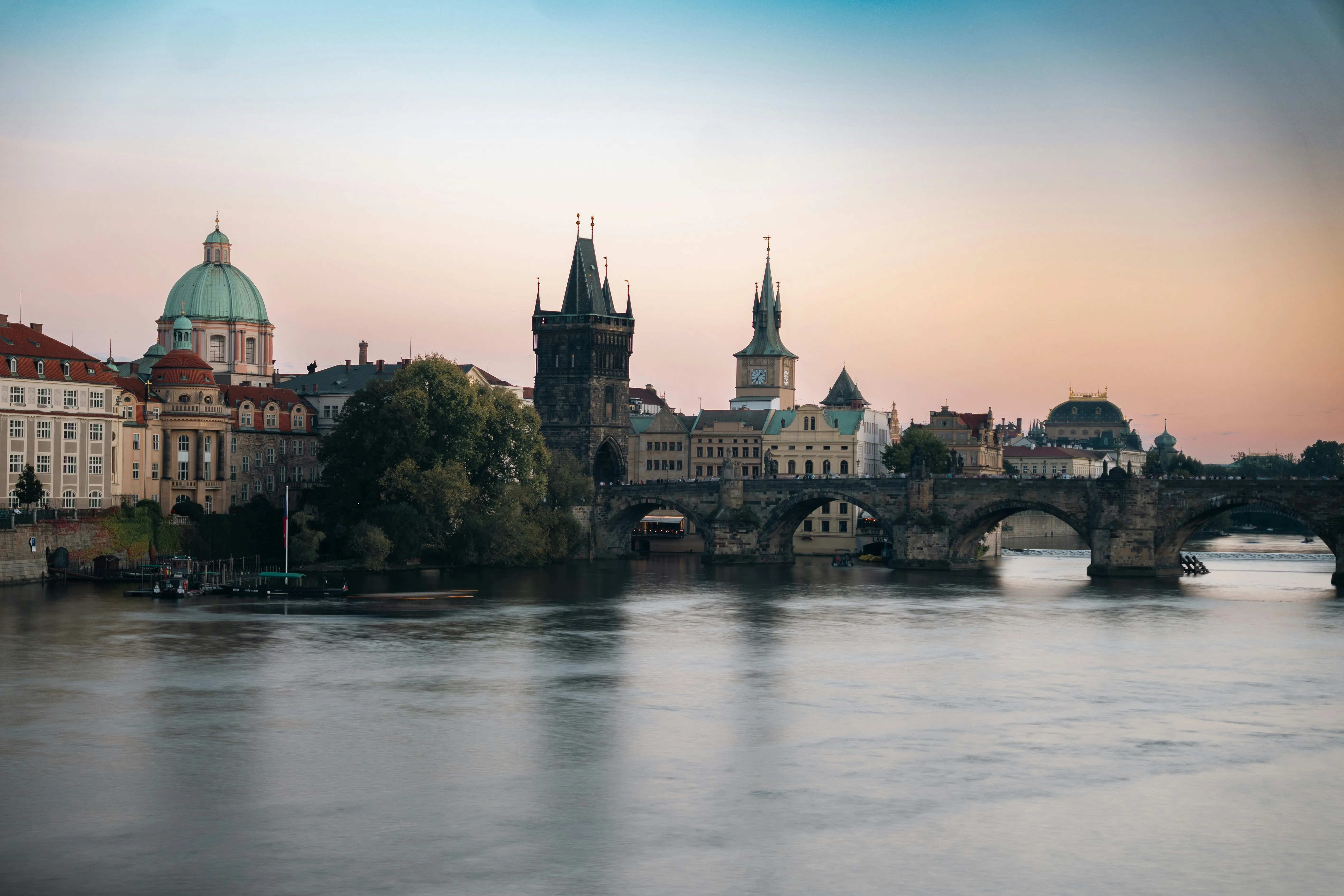
Prague captivates with Gothic architecture and 22 historic districts. The Czech capital ranks among Europe's safest city destinations for travelers.
Prague Castle dominates the city from the northwest and forms Prague’s actual center. Entry to the complex with St. Vitus Cathedral and the Royal Palace costs approximately 250 to 280 CZK (ca. $12–13 USD). St. Vitus Cathedral — officially the Cathedral of St. Vitus — stands as one of Europe’s largest Gothic churches, impressing with its vaults and stained glass windows.
Charles Bridge connects the Old Town with the Lesser Town across nearly 500 meters of stone. Its 14 arches have earned the bridge UNESCO World Heritage status since 1992. Early morning visits, before nine o’clock, reveal a far less crowded bridge than midday or afternoon hours.
The Old Town Square with the Astronomical Clock forms Prague’s pulsing heart. Every 15 minutes, figures emerge from the clock mechanism, attracting hundreds of onlookers. Medieval guild houses and palaces surrounding the square define the historic cityscape.
The Jewish Quarter encompasses the Old-New Synagogue from 1270 — one of Europe’s oldest still-functioning synagogues — and a 900-year-old cemetery with thousands of graves stacked several deep. A museum documents the lives of Prague’s Jewish community over centuries.
Vyšehrad Citadel, south of the Old Town, served as a medieval royal residence. Today the hilltop fortress above the Vltava River offers panoramic views of the city and a quietude that other attractions have lost.
Petřín Lookout Tower is an iron Eiffel Tower replica, 63 meters high, with a restaurant in its center. Clear days offer visibility up to 100 kilometers distant. Entry costs approximately 100 CZK (ca. $5 USD).
The National Gallery and Museum of Decorative Arts complete Prague’s cultural offering. Visitors interested in fine art or applied crafts will find European and Czech collections of considerable rank here.
Kutná Hora lies 65 kilometers east, reachable by train in 40 to 50 minutes. This UNESCO town served as a medieval silver-mining center. The notorious Sedlec Ossuary — a charnel house whose walls and chandeliers are fashioned from human bones — sits just outside town. Gothic architecture and the Cathedral of Saint Barbara merit equal attention.
Karlovy Vary, 120 kilometers west, is a spa town with thermal springs usable year-round. The train journey takes approximately two hours. Beyond bathing facilities, the Belle Époque cityscape and Bohemia Crystal manufactory draw visitors. The thermal colonnade and surrounding parks offer pleasant afternoon strolls.
Český Krumlov, 160 kilometers south, remains one of Europe’s best-preserved medieval town centers. Travel by minibus or train takes about 2.5 hours. A Renaissance castle overlooks the town, and narrow alleys of the Old Town invite leisurely exploration.
Terezín, 55 kilometers north, functioned as a concentration camp during World War II. The museum and memorials document this dark chapter. Train travel takes one hour; expect 20 minutes by bus thereafter. This visit demands time and emotional preparation.
Konopište Castle, 60 kilometers south, is a hunting lodge with collections of weapons and armor. Train access takes approximately one hour. Visitors interested in military history or castle interiors will find considerable material here.
Nerudova Street in the Lesser Town climbs from Nerudova Square toward the castle and receives far less mass tourism than Charles Bridge. Artists and craftspeople occupy studio spaces, and architecture feels more authentic.
The John Lennon Wall in the Lesser Town is an artistically painted surface covered with peace messages, quotations, and portraits. It originated in the 1980s as a protest site and remains a living artwork, constantly repainted and reimagined by new hands.
Riegrovy Sady Beer Garden is a park offering castle views where locals drink Czech brews with family and friends. This is Prague as lived by residents, not packaged tourist theater.
The Botanical Garden with Troja Palace in the north rarely sees tourist traffic. Visitors seeking green space and crowds elsewhere find refuge here.
May through September offers optimal conditions with temperatures ranging from 20 to 25 degrees Celsius and minimal rainfall. April and October represent shoulder seasons with 13 to 15 degrees — cooler but significantly less crowded, often cheaper for accommodations.
June is the sunniest month with approximately nine hours of daily sunshine. Days are long, and rainy days remain infrequent.
July and August bring warmth (24 to 25 degrees) but arrive during peak season. Hotels cost more, attractions overflow with visitors, and Charles Bridge sometimes becomes impassable on foot.
December brings Christmas market season — cold (minus 1 to 3 degrees) but atmospherically rewarding. Those drawn to traditional Christmas markets should prioritize this month.
| Jan | Feb | Mar | Apr | May | Jun | Jul | Aug | Sep | Oct | Nov | Dec |
|---|---|---|---|---|---|---|---|---|---|---|---|
| Low | Low | Low | Sweet Spot | Peak | Peak | Peak | Peak | Sweet Spot | Sweet Spot | Low | Low |
3° -2° | 5° -1° | 9° 0° | 15° 5° | 20° 10° | 23° 14° | 25° 16° | 24° 15° | 20° 11° | 14° 6° | 8° 2° | 3° -1° |
The greeting “Dobrý den” (Good day) carries formal weight, accompanying the use of Sie (formal address). Among acquaintances, the tone shifts to “Ahoj” (Hi) with informal address. After 6 p.m., “Dobrý večer” (Good evening) becomes appropriate.
Tipping in restaurants is customary but not obligatory as in the United States — approximately 10 percent for good service suffices. This often takes the form of rounding up the bill.
Shops typically open at 10 a.m. and close at 6 p.m. weekdays. Saturday hours run 10 a.m. to 2 p.m. Many close on Sundays — those needing provisions on Sunday should seek supermarkets within shopping centers.
Beer holds cultural significance in Czech culture. The nation consumes approximately 140 liters per capita annually — more than any other country globally. Bohemian pilsner (Pilsner Urquell) enjoys worldwide fame, though smaller breweries offer excellent local varieties.
Christmas (Vánoce) and Easter (Velikonoce) traditions run deep. Christmas brings markets (Vánoční trh) throughout the city, roasted goose, and gingerbread. Easter features processions and egg-painting traditions.
Cannabis has been partially decriminalized since 2026, with small amounts for personal use no longer subject to prosecution. Import and export remain criminal offenses.
Pickpocketing on Charles Bridge, Old Town Square, and in the metro during rush hours is reality, not alarmism. Valuables belong in inner pockets; backpacks deserve constant attention; cross-body bags should be worn at the front.
Unlicensed taxis present a real problem. In downtown Prague, unregistered taxi drivers overcharge tourists substantially. Ordered taxis (via Uber or Bolt apps or by phoning major companies) prove reliable.
Street money exchange ranks among classic fraud methods. Counterfeit bills are possible, and rates prove far worse than at ATMs or banks. Automated teller machines are ubiquitous and dispense legitimate currency.
Careless photography in Jewish cemeteries and memorial sites represents a breach of respect. These locations demand quiet attention, not Instagram hunts.
The alcohol limit while driving in Czech Republic is precisely 0.0 percent — zero tolerance. Fines range from $107 to $535 (approx. 2,300–11,400 CZK), and licenses can be confiscated.
Václav Havel Airport lies 15 kilometers west of Prague. A shuttle bus costs approximately 100 CZK (ca. $5 USD) and requires 30 minutes to reach downtown. Taxis cost roughly 200 to 250 CZK (ca. $9–12 USD). Uber and Bolt offer alternatives, often cheaper than conventional taxis.
Public transportation comprises three metro lines (A, B, C), 36 tram lines, and bus service. A 90-minute ticket costs 50 CZK (ca. $2.35 USD); a day pass runs 150 CZK (ca. $7 USD). Tickets require validation at entry using automatic machines present in every metro and tram.
The metro is modern, clean, and frequent, but pickpocketing occurs during rush hours (7–9 a.m. and 4–6 p.m. weekdays). Late-night travel in sparse cars carries additional security considerations.
Bicycle rental enjoys popularity, with infrastructure well-developed. Daily rental costs approximately 100 CZK (ca. $5 USD). Stations operate throughout downtown. Cyclists should note that Czech drivers show less tolerance for bikes than German or Dutch counterparts.
A rental car is unnecessary for city exploration and becomes rather impractical — parking proves difficult and expensive (premium rates in downtown). For day trips to destinations like Kutná Hora or Český Krumlov, however, an automobile offers flexibility and spontaneity.
German and EU citizens require valid ID cards or passports. Validity must extend throughout your entire stay. No buffer is required by law, though practically six additional months validity remains standard (Schengen convention).
Visas are not required for stays up to 90 days within 180 days. This follows Schengen rules.
Hotel check-in demands valid identification from every guest (including children). This is Czech law. Private accommodations (Airbnb, private rentals) require registration with local authorities, though proprietors usually handle this.
Crossing from Germany to Czech Republic falls within the Schengen zone — no border controls exist by air, road, or rail.
A driver’s license can be an EU document; an International Driving Permit (IDP) is optional but recommended. Motorists must obtain an electronic toll sticker (“Dálniční známka”) for highways, approximately 300 CZK for ten days (ca. $14 USD). Driving without one incurs fines.
Hepatitis A has experienced elevated case numbers since 2025 in Prague and surrounding regions. Vaccination is recommended for stays longer than four weeks. Standard hygiene — frequent handwashing with soap — remains advisable regardless.
FSME (tick-borne encephalitis) is endemic in certain regions. Those planning extended time in forests or parkland should consider vaccination.
Tap water is clean, high-quality, and safe to drink.
The European Health Insurance Card (EHIC) suffices for medical emergencies. Private travel health insurance remains worthwhile.
Pharmacies (“Lékárna” in Czech) stock prescription and over-the-counter medications. EU prescriptions see partial acceptance; Czech prescriptions work universally. Many OTC preparations are readily available.
In emergencies, dial 112 for police, fire, or medical services.
The Czech Republic ranks among the world’s top 10 safest nations by the Global Peace Index. No terror warnings exist from German authorities. Standard safety measures applied in major German cities prove sufficient here.
Discover Europe's cities in autumn without crowds. Architectural masterpieces and hidden gems for the culturally curious traveler.
Discover Europe's best cultural museums and galleries beyond the Louvre. Essential institutions and hidden gems across London, Vienna, Amsterdam, and more.
A short trip need not be superficial. With deliberate route planning, you discover the cultural and architectural substance of Europe in three days — not merely the facades.
To truly understand a city, spend time in its markets. Street-food cultures reveal urban history, local identity, and social structures in immediate ways.