List
Family-Friendly Hidden Gems: Europe's Alternatives
Discover underrated European family destinations away from tourist crowds—with practical tips for school holidays, budgets, and mixed ages.
TravelFeelings Editorial Team13 min.
Italy · Northern Italy
Lake Garda is Italy's largest lake, combining lakeshore climate with Alpine panorama. A handbook for family vacations, water sports, and cultural excursions into the hinterland.
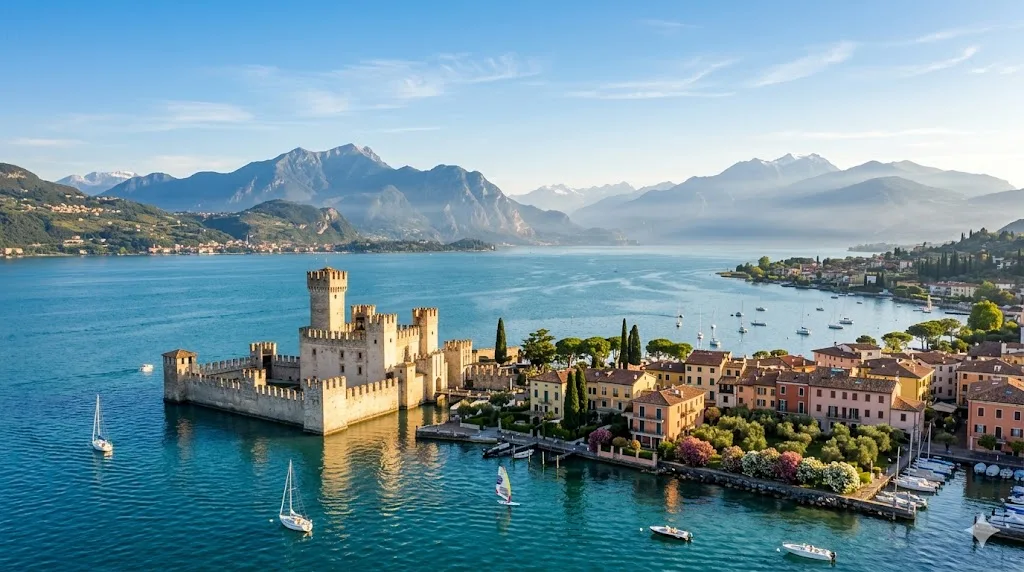
Scaliger Castle Sirmione dominates a peninsula and ranks among Italy’s best-preserved medieval water fortresses. The complex dates to the 13th century and belonged to the Veronese Scaligeri family. Tours of towers, ramparts, and interior spaces cost around $4–6 (approx. €4–6) admission. Note: During high season (July/August) visit before 09:00 or after 17:00 to avoid crowds.
The Grottoes of Catullus in Sirmione are Roman ruins of an ancient villa from the 1st century AD. Remains still show mosaics and foundation work. Admission around $3–4 (approx. €3–4). The site reveals how wealthy Romans used lakeside residences—not for daily living, but for leisure pursuits.
Jamaica Beach in Sirmione is a sheltered bathing cove with pale stone surfaces. Free access. Water quality is good; limited capacity means crowding during high season.
Scaliger Castle Malcesine sits on the east shore and houses a museum with displays on local fishing traditions and regional natural history. Admission around $4 (approx. €4). Malcesine itself is a colorful hamlet with narrow lanes—touristy but less crowded than Sirmione.
The Funivia del Monte Baldo is a cable car with rotating cabins ascending from Malcesine to 2,222 meters in ten minutes. On clear days, views span the lake, Alps, and three countries (Italy, Austria, Switzerland). Round-trip around $20–25 (approx. €20–25). Up top: hiking trails, via ferrata climbs, paragliding base. Winter brings limited ski runs. The experience is technically sound, the views substantial.
Riva del Garda on the north shore is a port town and water sports hub. The 13th-century Torre Apponale dominates the square. Free to explore. The town shows vitality without excessive tourist kitsch. The Gardone waterfall is reachable on foot from town (45 minutes).
The Giardino Botanico Hruska in Gardone Riviera displays Alpine and Mediterranean flora side by side. Admission around $8–10 (approx. €8–10). The garden sits at 370 meters elevation and reveals Lake Garda’s botanical uniqueness: a transition zone between south and north.
Arco to the north combines fortress and climbing destination. The castle offers views; admission around $3–4 (approx. €3–4). The town serves as base for climbing routes in the Sarca Gorge. Climbers from across Europe come here—world-class routes, many accessible to beginners with guides.
Verona lies 50 kilometers south and is reachable by regional train (about 60 minutes, $15–18 / approx. €15–18). The Arena di Verona is a Roman amphitheater still in use (opera performances June–September). The old town shows medieval plazas: Piazza delle Erbe and Piazza dei Signori remain civic and administrative centers historically visible. A day trip requires 6–8 hours on-site.
Monte Baldo is accessible via cable car from Malcesine (see Top Attractions). The mountain itself is destination for hikers, mountain bikers, and via ferrata enthusiasts. In summer, daily 8–10 sunshine hours at the top; weather changes rapidly—check forecasts. Equipment (water, sun protection, sturdy shoes) is non-negotiable.
Mantua lies 40 kilometers east (60-minute train, $12–15 / approx. €12–15). The city displays Renaissance squares and Palazzo Ducale (Ducal Palace)—less touristy than Verona. Compact and walkable on foot. Day trip 5–7 hours.
Arco and the Sarca Gorge to the north are 30 kilometers away (car required). The gorge shows spectacular rock walls and is climbing paradise. Hikes range from two to five hours. Difficulty varies widely—beginners should hire guides ($20–30 / approx. €20–30).
Lago d’Idro to the west is an Alpine lake, less touristy than Lake Garda. 45-minute drive. Water sports possible; clubs rent equipment. The lake offers quiet when Lake Garda fills up.
The Busatte-Tempesta panorama path runs between Torbole and the village of Tempesta along steep rock walls. Metal stairways secure the route and offer constant lake views. Not tourist-heavy; hike time around 2–3 hours, technically easy but exposed. Go early morning to avoid heat.
Ponale Waterfall near Riva del Garda is reachable only by kayak or stand-up paddleboard. A hidden spot for the few, not on standard itineraries. Kayak rental in Riva ($15–20 / approx. €15–20 for two hours). The waterfall itself is modest, but paddling around the lake from water level shows the shoreline differently than from land.
Bardolino and Brenzone on the east shore are former fishing villages with preserved historic fabric. Bardolino is known for its eponymous wine (light, fruity, under 13% ABV). Brenzone is quieter. Both reachable by bus or car, less touristy than Sirmione.
Campione del Garda on the west shore is a kitesurfing hotspot with wind guaranteed June through August. The place interests non-surfers too: few crowds, local bars, relaxed atmosphere. Check wind forecasts before visiting.
| Jan | Feb | Mar | Apr | May | Jun | Jul | Aug | Sep | Oct | Nov | Dec |
|---|---|---|---|---|---|---|---|---|---|---|---|
| Low | Low | Sweet Spot | Sweet Spot | Sweet Spot | Peak | Peak | Peak | Sweet Spot | Sweet Spot | Low | Low |
8° 2° | 10° 3° | 13° 5° | 18° 9° | 23° 14° | 28° 18° | 29° 20° | 28° 19° | 25° 16° | 19° 11° | 12° 6° | 8° 3° |
High season (June to September) brings warmth (26–29°C / 79–84°F) and ideal water sports conditions. Simultaneously, hotels fill and attractions crowd—especially July and August with school holidays. Those averse to crowds should skip this window.
Nearly unmatched is April through May: temperatures climb to 18–23°C (64–73°F), rainfall increases but not daily. Nature greens up; hiking is pleasant. Hotels have availability. Swimming water is marginal (14–16°C / 57–61°F) but possible for hardy swimmers.
September and October offer similar advantages to April/May but with warmer air (16–25°C / 61–77°F) and lighter rain. September offers the best balance between weather, water sports wind, and crowd levels.
November through March is low season. Temperatures drop to 4–12°C (39–54°F). Rain is frequent. Many hotels close or reduce staff. Activities are limited. This window appeals to those seeking nature without tourist masses—and to budget-conscious travelers.
Lake Garda sits in a border region: northern Italy adjoins German-speaking territory (South Tyrol/Trentino). Trentino historically spoke German and Ladin (in the south). This shows in architecture—houses with Alpine-style balconies, exterior frescoes characteristic of northern Italian tradition. In villages, dialects resound that would be unfamiliar to southern Italians.
Lake culture at Garda is shaped by thermals: mornings bring Bora wind from the north; midday shifts to Ora (southerly), predictable June through September. Windsurfers and sailors schedule days around this cycle.
Cuisine: The lake is borderland between Alpine cooking (spätzle, dumplings, sour cream) and southern Italian (pasta, olive oil, capers). Locally, lemon is signature—lemonades, gelato al limone (lemon ice cream), lemon liqueur. Grape wines, notably Bardolino (red Corvina grape), are local production. Restaurants follow Italian meal timing: lunch 12:00–14:00, dinner 19:30–22:00.
Tipping is not obligatory. In restaurants, 5–10% is optional if service was good. At bars, rounding up is custom (not calculated percentages at restaurant tables).
Dress code is relaxed Mediterranean. In churches, shoulders and knees should be covered—not optional, as churches remain sacred spaces, not museums. Beach culture: strands are freely accessible and swimwear varies; FKK zones are tolerated in some areas but not standard.
Visiting high season without early-or-late strategy is unwise. Scaliger Castle Sirmione and Jamaica Beach are swamped 11:00–16:00 with school groups and bus tours. Those expecting authenticity go before 09:00 or after 17:00. Parking is available by 08:00; after 10:00 searching becomes frustrating.
Underestimating water safety is dangerous. The lake looks calm but undercurrents and temperature gradients are significant. Divers report visibility under five meters below ten-meter depth. Swim only in designated zones. Dive only with certification and local guides. Water temps: January 4–5°C (39–41°F, hypothermia risk after 30 minutes), August 24°C (75°F, pleasant but unsafe for novices over deep ground).
Overestimating the Gardaland amusement park wastes money. The park is popular family destination but costs $45–55 (approx. €45–55) per person and shows standard carousels and slides without regional character. Money wasted on cultural exploration.
Driving the SS249 lakeside road is suboptimal. The route is narrow, winding, and congested July/August with tourist vehicles. Public transport (bus, train) is more reliable and stress-free. Parking in towns is limited—free only outside, centers have paid zones (around $1.50–2.50 / approx. €1.50–2.50 per hour).
Raw shellfish during Hepatitis A outbreak: In spring 2026, a Hepatitis A outbreak registered in Campania region (southern Italy), linked to mussel consumption. Lake Garda is freshwater—not directly affected. But raw mussels and oysters at Lake Garda itself can carry risk if staff hygiene lapses. Thoroughly cooked is safe.
Nearest airports for arrival are Verona-Villafranca (140 km, around 1.5 hours by car), Bergamo-Orio al Serio (100 km, around 1.5 hours), Milan-Malpensa (150 km, around 2 hours). Transfers via bus or car rental.
Car rentals are available from Verona and Bergamo airports. Budget-class costs $20–35 (approx. €20–35) daily (booked three weeks ahead). Refuel before return. Parking in towns: central zones cost $1.50–2.50 (approx. €1.50–2.50) per hour; outskirts free.
Multiple bus operators (ATV Verona, SAL Brescia, Trentino Trasporti) connect towns. Day tickets cost $8–12 (approx. €8–12) and cover broad routes. Schedules online (mobilitrentino.it for north, atv.verona.it for south).
The official shipping company Navigarda runs ferry connections for car transport (north-south crossing, about 30 minutes) and daily passenger sightseeing trips. Schedules vary June–September (daily), winter reduced. Tickets around $5–8 (approx. €5–8) per person.
Regional trains link Verona Porta Nuova with Peschiera del Garda, Desenzano, and Brescia (30–45 minutes). Frecciarossa high-speed trains serve longer routes (Verona-Milan, Verona-Bologna). Rail cards or group tickets save 25–50%.
The Funivia Monte Baldo (Malcesine) is the sole cable car at the lake, daily July–August, limited in winter. 10-minute ride, $20–25 (approx. €20–25) round-trip.
Optimal on-site mobility: book a centrally-located hotel (Sirmione, Desenzano, Riva, Malcesine) and use bus/ferry/cable car from there. Rent a car only if hinterland exploration (Verona, Mantua, Monte Baldo) is planned.
EU citizens need no visa for Italy. ID card or passport sufficient. Passport must remain valid for entire stay—no minimum validity beyond departure required (differs from non-EU countries).
Standard EU goods face no customs restrictions. Alcohol (2 liters wine, 1 liter spirits) and tobacco (200 cigarettes) in personal quantities are duty-free. Larger amounts must be declared.
Pets require pet passport, microchip, and current EU vaccination certificate (rabies). Dogs must be leashed and muzzled on public transport.
Auto travel requires: international insurance certificate (green card), German driving license document, vehicle registration, warning vest (one per occupant), two warning triangles, breakdown kit. Headlight adjustment for left-hand traffic (stickers) or replacement possible.
Hotel bookings should occur 3–4 months ahead during high season (June–August). Holiday rentals via Airbnb/Booking.com require similar lead times. Payment: credit card, bank transfer, or deposit arrangement.
Stays exceeding 90 days: residence registration with municipal town hall (Comune) required. Non-EU citizens need separate permission—not relevant for EU travelers, but status shifts after 90 days continuous stay.
No mandatory vaccinations required for direct entry from Germany. Hepatitis A is optional (Campania outbreak spring 2026, not lake-direct, but caution with raw meals applies). Malaria irrelevant. Standard vaccines (diphtheria, tetanus, polio) should be current.
Tap water is potable throughout Italy. Quality in major towns (Desenzano, Sirmione, Riva) is excellent (similar to Germany). Rural areas and vacation homes may vary—filter pitcher or bottled water is a precaution.
Pharmacies are in every town. Staff often speak English and German in tourist areas. Over-the-counter meds (headache, stomach upset) available without prescription. Emergency pharmacies (Farmacie di Turno) in larger towns operate 24/7.
Emergency ambulances (Pronto Soccorso) are available in Desenzano, Sirmione, and Riva. Insurance: EU health insurance card (EHIC) covers basic care. Private insurance supplements usefully (dental, optometry, therapies).
Crime rates in the Lake Garda region are low. Pickpocketing in tourist centers is standard risk—don’t display valuables, use zipped bags, carry rucksacks front-side when crowded. Vehicle security: no valuables in view, windows closed, car locked.
Hikers and climbers on Monte Baldo have good cell signal near the cable car; higher elevations limited. Helicopter rescue available (expensive—private insurance prudent). Emergency: 112 (Carabinieri/Fire/Ambulance).
Summer (June–August) brings temperatures to 29°C (84°F). Sun exposure demands sunscreen (SPF 50+), hat, fluid intake—non-negotiable. Dehydration is the most common vacation emergency. Siesta breaks 12:00–16:00 are cultural norm and healthful.
Discover underrated European family destinations away from tourist crowds—with practical tips for school holidays, budgets, and mixed ages.
How to travel with teenagers without everyone hitting the breaking point – strategies for shared moments and necessary independence.
Practical tips for calm flights with kids — from seat selection strategies to proven entertainment and snacks.
Jet lag doesn't have to derail family trips. With the right strategies for flight timing, light exposure, and sleep routines, families can manage time zone changes smoothly.